Overview
At a glance
Is this game right for my group?
ABG editorial scores on a 1–5 scale.
Harder to teach
High replayability
Highly interactive
Scales well
Deep strategy
How it plays
How does it play?
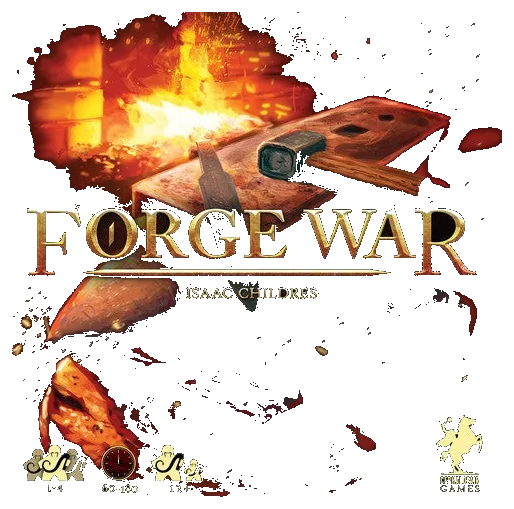
In Forge War, players will take on the role of blacksmiths in a kingdom rife with marauding harpies, cursed dungeons and fire-breathing dragons.
Core mechanisms
Key systems that shape the decisions players make.
Grid Movement
Move pieces between adjacent spaces on a regular grid.
Role Playing
Make decisions or communicate from the perspective of an assigned character.
Worker Placement
Commit limited workers to action spaces before opponents occupy them.
Modular Board
Build the play area from interchangeable sections that vary between games.
Hexagon Grid
Use a hexagonal map where each space connects evenly in six directions.
Variable Phase Order
The order of phases changes according to player choices or game state.
Read the full game description
In Forge War, players will take on the role of blacksmiths in a kingdom rife with marauding harpies, cursed dungeons and fire-breathing dragons. They are charged with gathering ore from the mines, purchasing weapon designs from the market and then using these resources to forge weapons for adventurers who will go on quests to fight back the ever-deepening darkness. If the adventurers are successful, they will return with more ore, money and other rewards with which players can invest back into their burgeoning weaponsmithing empire. At its core, Forge War is a rewarding game of aggressive investment, which occurs through the acquisition of quests. Quest management becomes challenging for the player, however, because quests undertaken aren't completed immediately, but instead progress each turn and become more difficult. At specific time intervals, players will need to add more resources to their quests or face failure. Gameplay cycles through three different phases in each round. The first phase consists of moving pieces around a hex grid to maximize resource production. The second phase is a market phase that features an action blocking mechanic to gain access to new weapon plans and other advantages. The final phase is the acquisition and management of quests, which are selected from a pool of available cards.