Overview
At a glance
Is this game right for my group?
ABG editorial scores on a 1–5 scale.
Harder to teach
High replayability
Highly interactive
Scales well
Deep strategy
How it plays
How does it play?
Description from the publisher: FLINK (F + link) is a connection game that uses the ‘F’ pentomino. EQUIPMENT 20 white ‘F’ pentominoes.
Core mechanisms
Key systems that shape the decisions players make.
Read the full game description
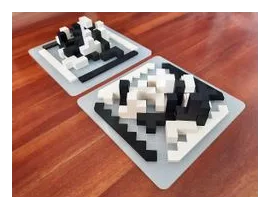
Description from the publisher: FLINK (F + link) is a connection game that uses the ‘F’ pentomino. EQUIPMENT 20 white ‘F’ pentominoes. 20 black ‘F’ pentominoes Dual board Carrying case Starting with White, players alternate turns placing one of their pentominoes on the board in any position (even standing vertically) following these placement rules: a) The piece must align with the square grid. b) It must be completely placed inside the board grid (coloured area). c) It must be fully supported by either the board or pieces below it; i.e. no overhangs are allowed. The game ends when, at the end of her turn, one of the players has connected the two sides of her colour. The path connecting the two sides of the board must be continuous along the surfaces of the same colour; however, the path can travel along the exposed top or any exposed side of a tile. This means that blocking your opponent is harder than you think! Flink is somehow reminiscent of Stefan Kögl’s Caminos (2010), which in turn resembles Cameron Browne’s Druid (2004), on which Flink was inspired. Flink distils the mechanism to use a single piece shape, and introduces the innovation of the connecting path being traced like an insect walking along the tops and sides of the pieces to get to the other side. Of course, all of these games (and numerous others) owe their existence to the original connection game: Hex (AKA CON-TAC-TIX, Piet Hein, 1942).