Overview
At a glance
Is this game right for my group?
ABG editorial scores on a 1–5 scale.
Harder to teach
High replayability
Highly interactive
Scales well
Deep strategy
How it plays
How does it play?
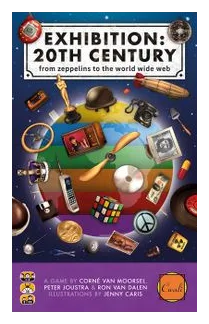
Goal of the game: Each player tries to make the best exhibition about the 20th Century. 100 20th century objects (each object at 1 of 100 cards, 1 card for each year (1900-1999)) are available to place in your exhibition.
Core mechanisms
Key systems that shape the decisions players make.
Read the full game description
Goal of the game: Each player tries to make the best exhibition about the 20th Century. 100 20th century objects (each object at 1 of 100 cards, 1 card for each year (1900-1999)) are available to place in your exhibition. Objects varying from the first Oscar award statue (1929) to Rubik's Cube (sold worldwide since 1980), the first bikini (1946) or flight recorder (1956), Euro coins (1999) or the last Tasmanian Tiger (1936), etc. etc. Each object belongs to 1 region: 19x North America 18x Europe 17x Asia 16x Africa 15x South America 14x Oceania 1x world (1945) (Kind of a "Joker" card, but that has positive and negative effects with placing, scoring and moving your zeppelin.) The available objects for your exhibition are placed in the center of the table in 6 groups of 3, each group placed at 1 of the 6 continents (colors). In your turn you take 1 of the 3 object cards at the continent where your zeppelin stands. You move your zeppelin to the continent equal to the continent of the card you took. You place a new random card from the stock to refill the open spot. Then you place the object in 1 of the 5 showcases in your exhibition hall (or in your depot). Each player tries to place the objects in their own showcases in accordance to general and showcase-specific requirements. The game ends if no player can fit a card in their exhibition anymore. For the victory points players try to fulfill goals the best, during the game and for the endscore. Some goals are individual, for other goals the players compete. —description from the publisher