Overview
At a glance
Is this game right for my group?
ABG editorial scores on a 1–5 scale.
Harder to teach
High replayability
Low interaction
Scales well
Deep strategy
How it plays
How does it play?
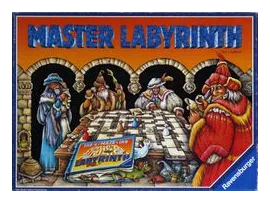
The wicked witch Grimelda has cursed the wizard Akata and imprisoned him in a magic book. As you are brave adventurers, you venture into the magic labyrinth to free the wizard – but you cannot do this without the help of its inhabitants.
Core mechanisms
Key systems that shape the decisions players make.
Modular Board
Build the play area from interchangeable sections that vary between games.
Pattern Recognition
Identify recurring visual, spatial, or logical arrangements.
Network and Route Building
Create connected routes that improve reach, delivery, control, or scoring.
Pick Up and Deliver
Collect goods at one location and transport them to another for rewards.
Set Collection
Gather related items that become more valuable when scored together.
Read the full game description
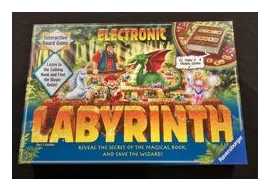
The wicked witch Grimelda has cursed the wizard Akata and imprisoned him in a magic book. As you are brave adventurers, you venture into the magic labyrinth to free the wizard – but you cannot do this without the help of its inhabitants. Visit the inhabitants and bring them certain items. You will receive coveted magic stones as a reward! The first player to fill his magic key with the magic stones and return to his starting field wins. But beware! Danger lurks everywhere... In Das Elektronik Labyrinth, designer Reiner Knizia marries his facility for electronics in board games (e.g., Wer war's? and Die Insel) with Max J. Kobbert's long-running Labyrinth series of games from Ravensburger. The basic game play is the same as in Labyrinth. The board has a set of tiles fixed solidly onto it; the remaining tiles slide in and out of the rows created by the fixed tiles to make up the labyrinth. One tile stands outside the labyrinth, and on a player's turn, he takes this tile and slides it into a row, moving all the tiles and pushing one out the other side of the board, which becomes the piece for the next player to add to the maze. After inserting the tile, the player may move his pawn. Each player starts on a corner of the game board and must reach the starting location diagonally opposite. If he manages to do so, he gains a number of magic stones. A player can also acquire magic stones from the inhabitants of the labyrinth. If a player lands on an inhabitant, it tells the players what item it desires. A player who finds the item, with items being scattered throughout the labyrinth, can deliver it to the inhabitant for a reward. What's more, an inhabitant may give a visiting player a treasure chest to be delivered to another inhabitant, also for a reward. In order to complete his magic key and free the wizard, a player needs fifteen magic stones. The first player that returns to his starting location with a complete key wins. The game comes with a "book" containing electronics. This book takes care of all the interactions with the inhabitants of the labyrinth. Whenever a player interacts with an inhabitant, he pushes the corresponding buttons from the book, and the book will respond by telling the player his assignment, reward, etc.