Overview
At a glance
Is this game right for my group?
ABG editorial scores on a 1–5 scale.
Harder to teach
High replayability
Highly interactive
Scales well
Deep strategy
How it plays
How does it play?
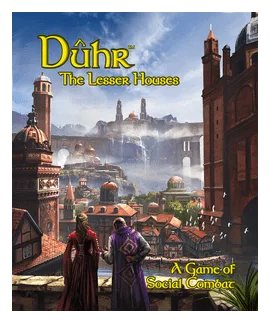
The monolithic city-state of Dûhr is at once a crucible of emerging and forgotten cultures, a cynosure of commerce, and a titan of military might. Its Great and Lesser Houses rise and fall with the whims of its Family Royal, the Sovereign House Kythidûhr.
Core mechanisms
Key systems that shape the decisions players make.
Trading
Exchange resources, assets, or promises with other players.
Hand Management
Time and sequence a limited hand of cards to preserve future options.
Take That
Direct negative effects at selected opponents.
Variable Player Powers
Each player has different abilities, restrictions, or strategic advantages.
Read the full game description
The monolithic city-state of Dûhr is at once a crucible of emerging and forgotten cultures, a cynosure of commerce, and a titan of military might. Its Great and Lesser Houses rise and fall with the whims of its Family Royal, the Sovereign House Kythidûhr. Amidst the festivals of summer, House Kythidûhr announced its intent to elevate one of Dûhr’s Lesser Houses to Great House status. By autumn’s frosts, the Lesser Houses were deeply embroiled in a fierce battle for the coveted title. Not with soldiers, for that would waste blood and gold, but with the most insidious of political weapons: suspicion and scandal. They attacked each other with aspersions and calumny, well devised and craftily exploited, designed to erode the social standing of their rival Houses and thereby remove them from contention. Dûhr: The Lesser Houses accommodates 4 to 6 players. Each player is the master of a Lesser House of Dûhr, vying for Great House status. Players take turns using cards in their hand to trigger events, place suspicions and scandals on each other’s House, or activate their own House’s unique ability to affect cards already placed. The accumulation of suspicion and scandal cards on a House card erodes the populace’s favor for that House by raising suggestions of wrongdoing or embroiling it in scandals that incite public outrage. All Houses begin the game without any suspicions or scandals and favored by the people of Dûhr. When a House accumulates a combined total of 5 suspicion and/or scandal cards, that House falls into disfavor with the populace. If a disfavored House ever has 3 or more revealed scandal cards, the House becomes vilified. The game ends immediately when the number of favored Houses remaining is 1 or none. Whoever has the highest score at that point wins the game. It is possible for a disfavored or vilified House to outscore a favored House and win the game! Pronunciation note: pronounce "û" in "Dûhr" like the "oo" in "doom."