Overview
At a glance
Is this game right for my group?
ABG editorial scores on a 1–5 scale.
Harder to teach
High replayability
Highly interactive
Scales well
Deep strategy
How it plays
How does it play?
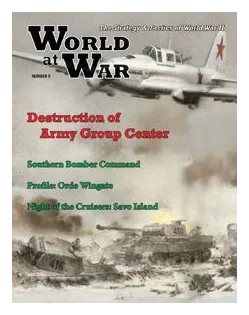
This new version of Destruction of Army Group Center is a thorough redesign, by Ty Bomba, of the game originally published by old-SPI in the early 1970s (in S&T#36).
Core mechanisms
Key systems that shape the decisions players make.
Read the full game description
This new version of Destruction of Army Group Center is a thorough redesign, by Ty Bomba, of the game originally published by old-SPI in the early 1970s (in S&T#36). The campaign under examination is “Operation Bagration,” the Red Army’s summer offensive of 1944 during which they destroyed more German manpower and equipment than had been lost at Stalingrad. Without question a one-sided affair in terms of which side is ‘shaping the battlefield’ and ‘controlling the tempo,’ we’ve managed to make things more interesting for both players by broadening the map to cover not only Byelorussia, but all of the Baltic Republics as well as the northwest Ukraine. That expansion gives both players more interesting options and strategies in terms of how to pursue victory. Each hex on the 34x22” large-hex map equals 16 miles (26 kilometers). Each of the nine game turns equals one week, from IV June through IV August. Units of maneuver are corps (and static “fortified localities”) for the Germans and armies for the Soviets. The latter’s great airpower advantage is represented in the form of 10 “air armies.” There are 176 large-size unit-counters included, most done in NATO-style, but also with iconic markers. The system is an adaptation of the one used in issue number three’s Bulge, which means two experienced players can finish a match in about three to four hours. The historical scenario provides exact set ups for both sides, but there are also free-deployment options. The “Bold Stroke” scenario allows the Soviet player to try the approach the Germans were expecting: putting the weight of the offensive in the western Pripyat Marsh and driving straight for Koenigsberg. Other options allow the investigation of such historical “what ifs” as the failure of the Western Allies’ D-Day landing or no July bomb plot against Hitler.