Overview
At a glance
Is this game right for my group?
ABG editorial scores on a 1–5 scale.
Harder to teach
High replayability
Highly interactive
Scales well
Deep strategy
How it plays
How does it play?
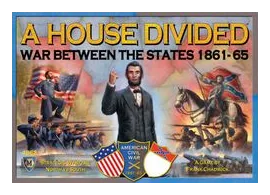
"This game is played by two people. One commands the northern forces, the other commands the southern forces.
Core mechanisms
Key systems that shape the decisions players make.
Grid Movement
Move pieces between adjacent spaces on a regular grid.
Point-to-Point Movement
Move along explicit connections between named locations or nodes.
Simulation
Model a real or imagined system through detailed cause-and-effect rules.
Static Capture
Capture opposing pieces through fixed positional relationships.
Square Grid
Use an orthogonal grid where position and adjacent spaces shape movement or placement.
Read the full game description
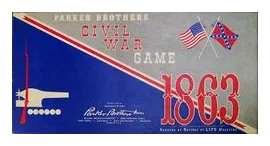
"This game is played by two people. One commands the northern forces, the other commands the southern forces. It is up to you as one of the commanders to develop the strategy and make the decisions which will give you the best chance to win. The course of the war is in your hands. At the beginning of the year 1863, the Confederate and Union armies were closely balanced. Either side could still win. There were differences - the North had more troops while the South had better ones with more mobility. But the decisive battles lay in the future. Final victory would be determined by the same factors for the Union and the Confederacy alike: sufficient fighting strength in the right place at the right time, daring and clever tactics, and luck. The players of this game must fight the same even fight. The same skill, daring and luck are required of you, if you want to win." - Taken from games rules introduction. User review: There are three types of units: infantry, cavalry, and gunboats. Infantry can move one space on land each turn. Cavalry can move up to two spaces on land each turn. Gunboats may move up to two spaces each turn and may transport infantry. Units may move orthogonally and diagonally. The gameboard is an 18 x 18 grid of squares. Starting places for the units, railroads, key cities, mountains, and important waterways are denoted. Players alternate taking turns with the Confederate player moving first. Combat occurs when opposing forces occupy the same space. The rules are more detailed but a larger force always defeats the smaller force. A player forces the opponent to remove units from play by capturing any of the opponent’s key cities. The player who eliminates all of the opponent’s units or gets the opponent to surrender is the winner. [27 December 2012] This game was first published in Life Magazine, volume 50 number 11, 17 March 1961. It was designed by three Life magazine staff members. This Parker Brothers edition was published subsequently, and is thus more accurately described as the second edition. Refer to the brief clip from Life magazine in the graphics.