Overview
At a glance
Is this game right for my group?
ABG editorial scores on a 1–5 scale.
Harder to teach
High replayability
Highly interactive
Scales well
Deep strategy
How it plays
How does it play?
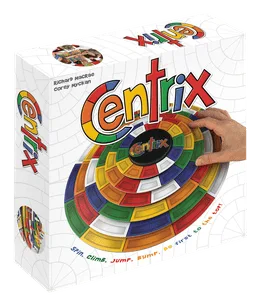
Centrix is a fun, friendly and family multi-level three dimensional game. Use Card combinations to rotate the rings of the game board and climb your play pieces to the top.
Core mechanisms
Key systems that shape the decisions players make.
Read the full game description
Centrix is a fun, friendly and family multi-level three dimensional game. Use Card combinations to rotate the rings of the game board and climb your play pieces to the top. Skillfully unlock the best route up the ever-changing game board. Use strategy and tactics to jump over as many play pieces as you can, and prevent other players from getting to the top first by bumping them down. Spin, Climb, Jump, Bump; Be First to the Top GAME MATERIALS - Game Board – Six multi-colored rotatable rings, with 12 colored squares each and a black, stationary top level; - 18 Pawns – Three of each in six different colors – red, orange, yellow, green, blue and white; - Deck of Cards – 42 playing cards, as follows: - 36 cards in six different colors and numbered 1, 2 or 3, - Three ‘any-color’ wild-cards, and - Three ‘unlimited-spin and any-color’ wild-cards. OBJECT OF THE GAME Move all three pawns up the six rings and enter them all onto the top stationary 7th level. First to do this wins the game. Second, third and fourth place winners follow continuing the game until the last pawn reaches the top level. PAWN MOVEMENT - Pawns always move by one, up down or sideways, but never diagonally; - Two pawns cannot occupy the same color square Jumping - A pawn can jump over or ‘leapfrog’ any pawn; - The number of pawns in a row that you can leapfrog is unlimited, provided that the color card played is the same color as the square that the pawn lands on; and - Jumping can start from the first move onto the board and even onto the top 7th level. Bumping - If the square above, adjacent or below is occupied, then you can bump that pawn directly down two levels, by playing the color card of that square and moving your pawn to the occupied square; - If another pawn occupies the square that your opponent’s pawn dropped down to, then that pawn also drops down two levels and so on (even if they happen to be your own pawns); - You cannot leapfrog up to bump an opponent’s pawn down two levels; and - Bumping is only possible by moving up one level, sideways or even down, if you choose to do so. CARD PLAY There are three types of cards in the deck: 1. Numbered color cards are the main cards used in playing the game. RING ROTATION - The number on a card is the number of squares that you can rotate a ring, 1, 2 or 3 either clockwise or counter-clockwise, as shown on the cards; - You can only rotate the ring level that your pawn is on; and - Rotating is optional, you can play the card as a color only card, but if rotating, then move the ring the same number of squares as the number shown on the card and always rotate the ring before playing the color. COLOR PLAY - The color on the card is the only square color that you can move a pawn to, when played; - If after rotating a ring, the square color above where the pawn arrives is the same as the color of the card, then you can climb up to that square, bump another pawn or leapfrog to a higher square of that same color, in a combination move. If not, then play a second color card if you have the color match. 2. Any-color wild-cards, allow you to move one pawn up, down or to an adjacent square from where your pawn is positioned, regardless of the color of that square: - The card also allows your pawn to climb, jump and bump, as explained in Pawn Movement above and to move up to the final 7th level; - This card cannot rotate any rings. 3. Unlimited-spin, any-color wild-cards, allow you to rotate one ring (optionally) any number of squares clockwise or counter-clockwise, provided that you have a pawn on that ring: - The card is subsequently also played as an any-color card, as described above. COURSE OF THE GAME - Youngest player goes first; - Play one card per pawn move, starting off the board; - The square color on which you place your pawn must match the card color (wild-cards are any color); - Play all three of your cards in your hand, if possible; - You cannot bump another player off the bottom first level; and - After you have played as many of the three cards as you can play, your turn ends, you draw new cards for a total of three cards in your hand and the next player takes a turn. END OF THE GAME - From the 6th ring level, play any numbered card that matches the color of your pawns or any of the wild-cards to move up to the 7th safe level at the centre of the game board; - You can leapfrog over other pawns to make this move; - Your pawns cannot be removed, once they reach the top level; and - When all three pawns are at the top, you’re done and if first to get there, you win the game.