Overview
At a glance
Is this game right for my group?
ABG editorial scores on a 1–5 scale.
Harder to teach
High replayability
Highly interactive
Scales well
Deep strategy
How it plays
How does it play?
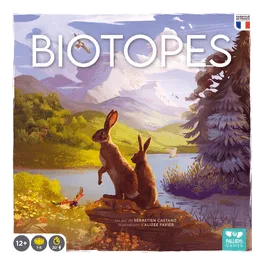
In Biotopes you will have to develop your ecosystem so that it to be as vibrant as possible. Colonize the central landscape, attract animal species and increase their populations.
Core mechanisms
Key systems that shape the decisions players make.
Deck / Bag Building
Add new pieces during play to improve the cards, tokens, or dice drawn later.
Modular Board
Build the play area from interchangeable sections that vary between games.
End Game Bonuses
Earn additional points for meeting conditions evaluated when the game ends.
Hexagon Grid
Use a hexagonal map where each space connects evenly in six directions.
Solo / Solitaire Game
Provide rules and objectives designed for a single player.
Read the full game description
In Biotopes you will have to develop your ecosystem so that it to be as vibrant as possible. Colonize the central landscape, attract animal species and increase their populations. A game of Biotopes is played in 5 or 6 Cycles depending on the chosen game mode. At the beginning of the game, you determine common sources of victory points. --These are the environmental conditions with which your ecosystems will have to deal in order to thrive.-- At the beginning of each cycle, you will draw cubes of four different colors from your bag and place them on the Biotope cards of those colors. --This represents the organic matter extracted from your soil by the plants in your Ecosystem.-- During the cycle you will take turns colonizing the central board and developing and optimizing your ecosystem. --The central board represents the landscape at a macro level in which the different ecosystems spread out and confront each other. Your board and cards represent your ecosystem at a micro level.-- Your actions on the central board will allow you to expand, move your territories and even take territories from your opponents. Your actions in your ecosystem will allow you to play animal species cards, feed them by transferring the resources produced by your plants and make them reproduce in order to make your ecosystem prosper. Finally, to best optimize your future cycles, you will need to draw new cards to deal with new situations. --The cubes on your animal species cards represent the population of that species in your ecosystem.-- Once you and your opponents have exhausted your options, the current cycle will end and you will start a new one. All the organic matter of your ecosystem used during this cycle will be put back in your bag, so it will be used again by your plants for the next cycle. Once all the cycles have been played, you can determine who wins the game by adding up all the victory points: --But be careful, if you have no more cubes on species cards, their populations will die out and they will not be taken into account for the calculation of victory points. Finally, beware of your distribution in the central landscape, a fragmented ecosystem is much less optimal and can grant malus.--