Overview
At a glance
Is this game right for my group?
ABG editorial scores on a 1–5 scale.
Harder to teach
High replayability
Highly interactive
Scales well
Deep strategy
How it plays
How does it play?
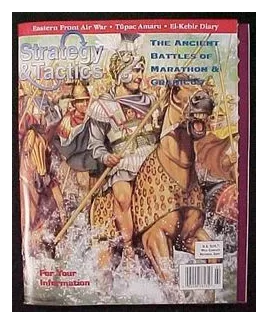
Marathon and Granicus uses the tried and tested Battles of the Ancient World system which now has clocked up an impressive 17 different battle scenarios spread over 3 boxed sets and 2 magazine game issues.
Core mechanisms
Key systems that shape the decisions players make.
Read the full game description
Marathon and Granicus uses the tried and tested Battles of the Ancient World system which now has clocked up an impressive 17 different battle scenarios spread over 3 boxed sets and 2 magazine game issues. The map is up to the usual high standard of S&T and ancient battles standard. The bay, rises, 2 streams as well as the Persian camp are clearly shown, although the Persian camp hexes sit pretty on the map but appear to have no effect on the game at all - no vps for the Greeks passing through or occupying the hexes at all. The functional counters show Persian footmen, cav and bowmen along with the Greek hoplites. Standard rules are used with specific scenario rules being the Greek charge in turn one which triples their movement, thus all hoplite units are able to crash into the Persian ranks on turn one, if the Greek player feels the urge - and it is advisable, as another rule states, that the disorganized Persian cavalry cannot move and would defend at half strength up until turn 4. Thus the Greek is encouraged to batter through some of the Persian foot and close with the cav before turn 4 if possible. All in all, a fine simulation given the scope of the system rules. The Persians' only good chance is to resist the Greek hoplites with foot until turn 4 and then try and turn any Greek flank possible, by moving their cavalry away and around the Greeks and charging them in clear terrain - if the Greeks allow themselves to be exploited this way, of course.