Overview
At a glance
Is this game right for my group?
ABG editorial scores on a 1–5 scale.
Harder to teach
High replayability
Highly interactive
Scales well
Deep strategy
How it plays
How does it play?
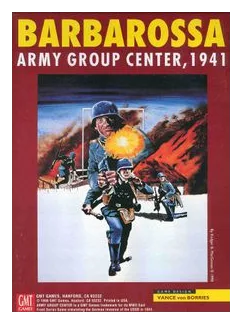
Historical Setting June 1941 -- Army Group Center hurls itself through the Soviet border defenses, and its two Panzer groups race headlong toward Minsk. Behind them lie the remnants of the Soviet Western Front -- almost a million men in four armies.
Core mechanisms
Key systems that shape the decisions players make.
Read the full game description
Historical Setting June 1941 -- Army Group Center hurls itself through the Soviet border defenses, and its two Panzer groups race headlong toward Minsk. Behind them lie the remnants of the Soviet Western Front -- almost a million men in four armies. The Soviets are stunned by the German Blitzkrieg. Their responses are slow, confused, and governed by pre-war contingency plans made obsolete by the speed of the German advance. In little more than a week, the German panzer spearheads meet east of Minsk. Though isolated units continue to fight, the entire Soviet Western Front has ceased to exist! The Germans' next target is Smolensk, but the Soviets resist more effectively. Entire armies are dispatched from other parts of the Soviet Union as the true scope of the Minsk pocket disaster and the magnitude of the German threat become known. Soviet counterattacks, especially around Lepel, are thrown back with horrific losses. Once again the Panzer Groups charge eastward, creating yet another huge Soviet pocket west of Smolensk. The Soviets resist savagely. Smolensk falls on July 13th, but the pocket does not close. Many Soviet units escape to fight another day. Hitler now makes a fateful decision and overrides his generals. Over half of Army Group Center's armored and air formations are diverted south to take Kiev or north to isolate Leningrad. No longer under heavy pressure, the Soviets gain time to form solid fronts around Vyazma and Bryansk. Did Hitler's decision cost the Germans the war? Play Barbarossa: Army Group Center and find out for yourself Game Features Eight scenarios allow players to vary their level of involvement, complexity, and starting point, from introductory to full campaign An asymmetrical sequence of play that highlights Axis armored breakthroughs and Soviet difficulties in combined arms warfare. This includes a “non-op” Soviet HQ system to simulate the rigid, yet fragile, Soviet Command structure Detailed air rules which integrate with land combat and weather rules Incredibly detailed Order of Battle, including special coverage of artillery, rocket artillery, engineers, bridge units, armored trains, and much more Modifications to the proven “EFS” include many revised rules and procedures, as well as new Order of Battle information Extensive bibliography and design/historical notes TIME SCALE 2 days per turn MAP SCALE 5 miles per hex GROUND UNIT SCALE Division/Regiment AIR UNIT SCALE 40-80 aircraft per counter NUMBER OF PLAYERS One to four COMPONENTS Four 22x34 inch full-color maps (Series Maps C, D, H, and I) One 22x8.5 inch map (Map WA) (in 2nd edition only) 1400 multi-colored die-cut ½ inch counters Rule Book Play Book Player's aid (from GMT website and BGG user's description) This is one of a very popular series of games from GMT covering the first months of the invasion of the USSR; units are battalions through divisions, hexes are about 5 miles, and turns are two days. The system encompasses (as of 6/2001) Barbarossa: Army Group North (2000), Barbarossa: Army Group Center (1998), and Barbarossa: Army Group South (1996). Typhoon! (1995) is the progenitor of these games, and its system is quite similar, but it is unfortunately subtly incompatible with the later games. While not simple, these games are also not overly complex and present an excellent simulation of the early war. Most of the details of the campaigns are covered in a playable manner. Perhaps the most obviously interesting detail is the sequence of play, which is asymmetrical to account for the difficulties the Soviets labored under. Make no mistake, the Soviets are going to take a lot of abuse, but this is no walkover for the Germans and both sides are interesting to play. (BGG user description) Errata counters contained in Barbarossa: Crimea.