Table feel
Moderate level of interaction with a good balance between direct and strategic confrontation. Players need to pay attention to each other's strategies and turns frequently, but there is not a heavy emphasis on cooperation.
Players
1-2
Time
?-?
Age
?+
Weight
3.33
Rating
6.83
Teaching signal
High replayability
Highly interactive
Scales well
Deep strategy
More strategic control
Moderate level of interaction with a good balance between direct and strategic confrontation. Players need to pay attention to each other's strategies and turns frequently, but there is not a heavy emphasis on cooperation.
Agricola: Roman Campaign in Britain, AD 82-84 has a high replayability score due to its variability in gameplay, strategic depth, and adaptability to different player counts. The game offers different experiences each time it is played, with multiple paths to victory and variable setups. The presence of expansions adds new content and gameplay elements, enhancing the replay value. The game allows room for players to improve their strategy over time, discovering new tactics and strategies. The player interaction score is moderate, and the game scales well with different numbers of players. While it may take some time to learn, the depth it offers makes it worth the effort. Overall, Agricola: Roman Campaign in Britain, AD 82-84 provides a fresh and engaging experience with high replayability.
The final luck score for Agricola: Roman Campaign in Britain, AD 82-84 is 7.33 out of 10. This indicates that random elements have minimal impact on the game outcome, and the game relies more on player decisions and strategy. Players have substantial ability to mitigate randomness through strategic decisions and planning. While there is still a balanced mix of luck and strategy, the game outcome is primarily determined by player strategy and decisions, with luck playing a minor role.
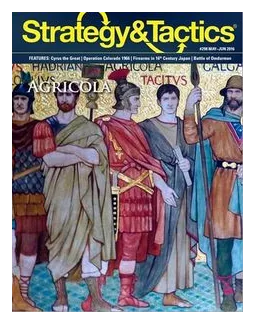
Agricola: Roman Campaign in Britain, AD 82-84 is a wargame reflecting the campaign fought by Gnaeus Julius Agricola, the Roman governor of Britain (AD 77-85) to conquer northern Britannia (modern Britain). There are two players, the Roman and the Caledonian (the latter actually representing various northern British tribes). Cardboard chits are used to represent units — military formations or tribal warbands. Each player has a set of Stratagem markers. Players use these markers to recruit new units, move their forces on the map, take special actions, and enhance operations. Components: One 22" x 34" map & 117 counters (Strategy and Tactics Magazine #306) Sep-Oct, 2017
No media imported yet.
| Edition | Year | Language | Publisher / Region |
|---|---|---|---|
| No editions imported yet. | |||
No files imported yet.
No linked items imported yet.