Overview
At a glance
Is this game right for my group?
ABG editorial scores on a 1–5 scale.
Harder to teach
High replayability
Highly interactive
Scales well
Deep strategy
How it plays
How does it play?
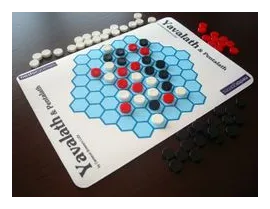
Yavalath is an abstract strategy game for two players. Players strive to make a straight line of 4 pieces of their colour, but lose if they make a line of 3 before doing so.
Core mechanisms
Key systems that shape the decisions players make.
Read the full game description
Yavalath is an abstract strategy game for two players. Players strive to make a straight line of 4 pieces of their colour, but lose if they make a line of 3 before doing so. The board (a hexagon 5 spaces on a side) is initially empty. Players take turns placing a piece of their colour on an empty cell. Yavalath was invented / discovered by a game-generating computer program developed by Cameron Browne as part of his Ph.D. research.