Overview
At a glance
Is this game right for my group?
ABG editorial scores on a 1–5 scale.
Harder to teach
High replayability
Highly interactive
Scales well
Deep strategy
How it plays
How does it play?
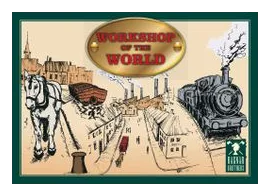
Description from BoardgameNews.com: The Ragnar Brothers return to canal-building in this new game set during the Industrial Revolution, which will be produced in an edition of 1,000 copies.
Core mechanisms
Key systems that shape the decisions players make.
Read the full game description
Description from BoardgameNews.com: The Ragnar Brothers return to canal-building in this new game set during the Industrial Revolution, which will be produced in an edition of 1,000 copies. Here's a game description from the back of the box: "For a brief period the Industrial Revolution burned so bright that Britain was known as the 'Workshop of the World.' This Ragnar Brothers' game recreates that dramatic time. Players establish their position on the map-board by investing in ports, heavy industries, textiles, light industries and crafts. Canal networks are built to connect the thriving towns. Expenditure is vast, but capital gains are greater. Next the railways are built and each player seeks to strengthen their industrial base. By game end, towns are linked from London to Wales, Scotland to the Channel ports. Wealth decides the winner." And here's the game play described in more detail: • The game lasts two eras – the Canal Era and Railroad Era – with players earning money at the end of each era. • Before starting an era, players each reveal one of their two demand tokens to show which towns (ports, textile locations, etc.) have special value. • Each era lasts a number of rounds, and in each round players reveal town cards equal to the number of players, then hold an auction for turn order. Players choose towns in turn order, placing an Industry marker on that location, then optionally building links from that town, ideally forming a network of links that connects their Industries. • Once the town cards run out, the era ends. Players (may) reveal their second demand token, then they collect money equal to their revenue (earned by connecting Industries with links), the demand value of their Industries, and the value of their largest network of links, with token payment for any remaining links. • Between eras, the game is reset Amun-Re-style, with revenues being zeroed out and all links being cleared from the board. Players' Industries remain in place, letting them build on their holdings in the second era, which otherwise plays out nearly identical to the first.