Overview
At a glance
Is this game right for my group?
ABG editorial scores on a 1–5 scale.
Harder to teach
High replayability
Highly interactive
Scales well
Deep strategy
More strategic control
How it plays
How does it play?
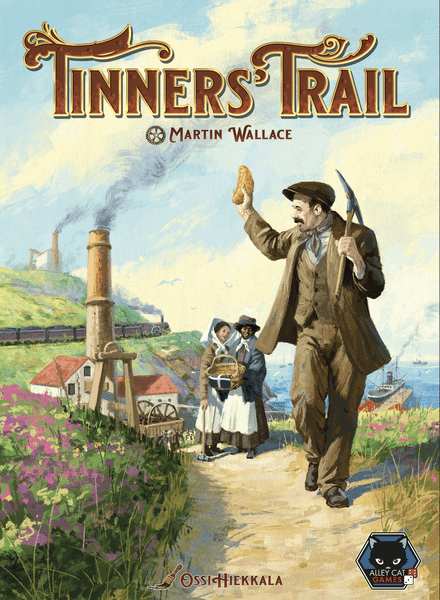
Build Cornish mines, bid for promising plots, control water and ore costs, sell tin and copper at the right moment, and invest the profit for victory points.
Core mechanisms
Key systems that shape the decisions players make.
Commodity Speculation
Buy or influence goods whose values change before they are sold or scored.
Market
Buy and sell through a shared supply whose availability or prices can change.
Auction / Bidding
Bid against other players to determine who receives an item, action, or priority.
Action Points
Spend a limited allowance of points across several possible actions each turn.
Dice Rolling
Roll dice to introduce uncertainty into actions, production, movement, or resolution.
Income
Receive recurring resources according to your position, assets, or development.
Read the full game description
Tinners' Trail (Second Edition) revisits Martin Wallace's economic contest in nineteenth-century Cornwall with a fifth-player option and a dedicated solo design. Players auction mining plots, spend work points to build and develop mines, and use ports, trains, adits, miners, and steam pumps to change the cost of extracting tin and copper. Ore prices shift each round, water dice make every mine a calculated risk, and money is useful only when converted into victory points during four investment phases. Auctions and a shared action clock force players to value both location and timing rather than simply expand. The result is a compact, interactive economic game in which every pound must earn its keep.