Overview
At a glance
Is this game right for my group?
ABG editorial scores on a 1–5 scale.
Harder to teach
High replayability
Highly interactive
Scales well
Deep strategy
How it plays
How does it play?
Think Again! — a.k.a.
Core mechanisms
Key systems that shape the decisions players make.
Read the full game description
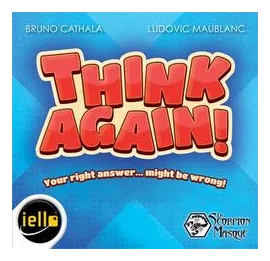
Think Again! — a.k.a. C'est pas faux! (French for "It's not false") — is a party trivia game in which all players know all the right answers – but where the right answer is not always what you are looking for. Players take turns reading questions. After a player finishes reading a question, he reveals the back of the next question card, which indicates whether the other players need to answer correctly or incorrectly. If the question card shows a green dot, the word "Right" or the genius (co-designer Bruno Cathala's face), players must give the correct answer. For the question "What color are the Smurfs?", the first player to answer blue scores a point. If the question card shows a red dot, the word "Wrong" or the dunce (co-designer Ludovic Maublanc's face), players must give a wrong answer. For the question above, the first player to answer any color EXCEPT blue scores a point. If you speak too quickly and give a correct answer when an incorrect one is required (or vice versa), you lose 1 point. After each player has asked five questions, the player with the most points wins. There are some absurd questions (e.g.: What colours are the letters of the alphabet?). It that case, the only correct answer is "Think again". Also include rule variants for play in teams over 3 rounds.