Overview
At a glance
Is this game right for my group?
ABG editorial scores on a 1–5 scale.
Harder to teach
High replayability
Highly interactive
Scales well
Deep strategy
How it plays
How does it play?
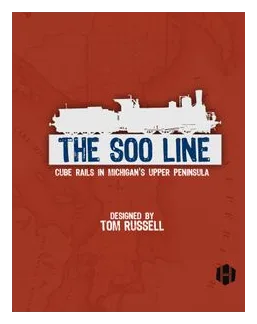
THE SOO LINE is a train game set in Michigan’s Upper Peninsula. As in many such games, the players invest in railroad companies, building track to increase the company’s income and paying dividends to the shareholders.
Core mechanisms
Key systems that shape the decisions players make.
Auction/Bidding
Bid against other players to determine who receives an item, action, or priority.
Network and Route Building
Create connected routes that improve reach, delivery, control, or scoring.
Pick Up and Deliver
Collect goods at one location and transport them to another for rewards.
Stock Holding
Acquire shares whose value depends on companies, assets, or player actions.
Ownership
Claim assets or areas that remain under a player’s control.
Hexagon Grid
Use a hexagonal map where each space connects evenly in six directions.
Read the full game description
THE SOO LINE is a train game set in Michigan’s Upper Peninsula. As in many such games, the players invest in railroad companies, building track to increase the company’s income and paying dividends to the shareholders. And as in several of Amabel Holland’s railroad games, track-leasing and cooperation is required to get past high build costs, strict hex limits, and tight cube supplies. Here’s the thing, though: this is a weird game. For one thing, there are only three railroads to invest in, and the majority shareholder makes all decisions when a company operates. This means that when playing with four or five, some players will not be running companies themselves, and will need to rely on savvy investments to stay competitive. Included in these investments are five Private Companies. Privates are seeded with goods at the start of the game and pay a fixed income each round, and each time a railroad delivers goods. Once their goods are gone, the Private closes and the owner derives no further benefit. If a railroad withholds money instead of paying dividends, its share value drops, sometimes drastically. Given enough time, the stock values for all three railroads will tank - the trick is to end the game before that happens, and when you have the most valuable portfolio. As is usually the case in these kinds of things, the winner is the player with the most money - cash on hand plus the value of your stocks. (Note, however, that no play money is provided. If you don’t have poker chips, greenbacks will do in a pinch and make the game very interesting.) Also, there is a cat on the priority deal card.