Overview
At a glance
Is this game right for my group?
ABG editorial scores on a 1–5 scale.
Harder to teach
High replayability
Highly interactive
Scales well
Deep strategy
How it plays
How does it play?
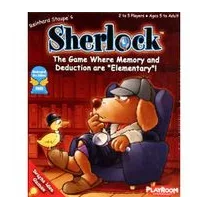
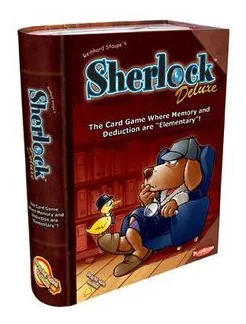
In Sherlock 13, first published as Holmes 13, the players take the role of a detective, trying to unmask the famous thief Arsene Lupin, who is among them in disguise. The game consists of 13 character cards, with 2 to 3 characteristics each.
Read the full game description
In Sherlock 13, first published as Holmes 13, the players take the role of a detective, trying to unmask the famous thief Arsene Lupin, who is among them in disguise. The game consists of 13 character cards, with 2 to 3 characteristics each. Each characteristic is shared by 3 to 5 characters. The cards are shuffled and one is drawn and put aside. This card represents the disguise chosen by Arsene Lupin. The other cards are distributed evenly among the players. The players now tally the total of characteristics they have on their cards (e.g. 2 detectives, 1 female, 0 genius etc) and note them for later use. Players now take turns, asking a question to gather new evidence: a.) To all players: "Who has (at least one) of (this characteristic)? OR b.) To one player: "How many of (this characteristic) do you have? Using these clues the players try to figure out which disguise Arsene has chosen (i.e. which card is missing). Instead of a question, a player may announce which character he suspects to be Arsene in disguise. That player then secretly checks the hidden card. If the suspicion was correct, this player wins the game, otherwise the player is eliminated and the other players continue.