Overview
At a glance
Is this game right for my group?
ABG editorial scores on a 1–5 scale.
Harder to teach
High replayability
Highly interactive
Scales well
Deep strategy
How it plays
How does it play?
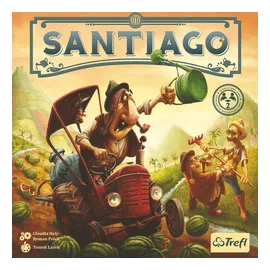
Santiago is about cultivating and watering fields. To accomplish this, a number of tiles denoting various plantation types come into the game each round.
Core mechanisms
Key systems that shape the decisions players make.
Area Majority
Compete to have the strongest presence in areas that award control or points.
Auction/Bidding
Bid against other players to determine who receives an item, action, or priority.
Commodity Speculation
Buy or influence goods whose values change before they are sold or scored.
Tile Placement
Place tiles to build a shared or personal spatial arrangement.
Bribery
Offer resources or incentives to influence another player’s decision.
Read the full game description
Santiago is about cultivating and watering fields. To accomplish this, a number of tiles denoting various plantation types come into the game each round. The tiles are auctioned off such that each player gets one, and the tiles are then placed onto the game board along with an ownership marker that also indicates how plentiful the tile's yield will be. Whoever bid the lowest in each round gets to be the canal overseer and decides where a canal will be built that round. The other players may make suggestions to help the canal overseer decide, and back up their suggestions with money. The final decision is always wholly up to the overseer, though. At the end of each round, players determine what the water supply situation looks like. Should a plantation not be sufficiently watered, its production drops dramatically; should it happen more than once, then that plantation may revert to fallow ground. At game's end, naturally only the cultivated land counts. Each plantation is counted according to type – the bigger the better. But since the ownership markers play a role as well, the same plantation can give drastically different points for different players.