Overview
At a glance
Is this game right for my group?
ABG editorial scores on a 1–5 scale.
Harder to teach
High replayability
Highly interactive
Scales well
Deep strategy
How it plays
How does it play?
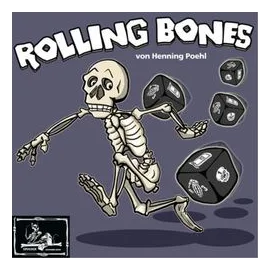
In Rolling Bones players use 18 special dice – six showing parts from the left side of the body, six showing parts from the right, and six showing parts from the middle (skull, ribcage, spine, pelvis) plus a hat and a gravestone – to build a skeleton, adding to it roll by roll, in order to score points. The better the skeleton buried, the more you score!
Core mechanisms
Key systems that shape the decisions players make.
Read the full game description
In Rolling Bones players use 18 special dice – six showing parts from the left side of the body, six showing parts from the right, and six showing parts from the middle (skull, ribcage, spine, pelvis) plus a hat and a gravestone – to build a skeleton, adding to it roll by roll, in order to score points. The better the skeleton buried, the more you score! The first roll of a player's turn is the "pre-op" roll, with the player launching all 18 dice onto the table. The player then builds as complete a skeleton as he can with no gaps. For each subsequent "post-op" roll – if a player chooses to roll or is forced to roll – the player must first set aside a number of dice equal to the number of rolls already made: one die for the first post-op roll, two more dice for the second post-op roll, and so on. The player must add at least one die to the skeleton after each roll. If a player can't place a bone correctly, he must add an incorrect bone in the wrong location, e.g., a foot on the end of the spine. Whenever a player has a gravestone showing, the player can choose to end his turn, scoring for his skeleton. Each complete section (arm, leg or thorax) is worth five points, with each incomplete section worth one point per die in it. Each incorrectly placed die costs the player five points. If a player's skeleton wears a hat (which naturally goes only on top of the skull), double the score for that round. If a player has no gravestone and cannot pay for another reroll, he ends his turn scoring nothing. The first player to reach 100 points (or some other agreed upon total) wins Rolling Bones.