Overview
At a glance
Is this game right for my group?
ABG editorial scores on a 1–5 scale.
Harder to teach
High replayability
Highly interactive
Scales well
Deep strategy
How it plays
How does it play?
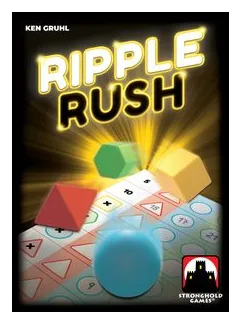
How many spaces can you fill on your scoresheet in Ripple Rush, a quick and simple flip-and-write game? In the game, you have your own player sheet, which shows four columns of symbols (square, circle, triangle, hexagon), with eight symbols in each column.
Core mechanisms
Key systems that shape the decisions players make.
Read the full game description
How many spaces can you fill on your scoresheet in Ripple Rush, a quick and simple flip-and-write game? In the game, you have your own player sheet, which shows four columns of symbols (square, circle, triangle, hexagon), with eight symbols in each column. To set up the game, adjust the deck so that it contains twenty cards per player, with the cards being chosen at random. The full deck contains one hundred cards, with 25 cards for each symbol numbered 1-25. On a turn, each player draws a card from the deck, then (if possible) you write the number on that card in the column matching the depicted symbol. Numbers must be placed in columns in ascending order so that within each column each number is higher than whatever is below it and lower than whatever is above it, but you can skip spaces in the columns when entering a number. If you can't place your card's number on your player sheet in the proper column — e.g., you draw a blue 14 and you have no open spaces between a blue 11 and a blue 15 — announce this to everyone before they write down the number on their own card and place your card in the center of the table. After they write their own number, they can also write your number on their score sheet, if possible. If you complete a row of symbols, then you immediately get the bonus shown on the left edge of the player sheet, either a number (5, 10, 15, 20) that you can write in any valid column or a symbol that you can fill with any valid number. At game's end, for each column you score points equal to your longest connected sequence of filled-in spaces. In the advanced variant, you draw two of the eight bonus cards, each of which shows one of the rows on the player sheet; for each of these two rows that you fill in completely, you score bonus points.