Overview
At a glance
Is this game right for my group?
ABG editorial scores on a 1–5 scale.
Harder to teach
High replayability
Highly interactive
Scales well
Deep strategy
How it plays
How does it play?
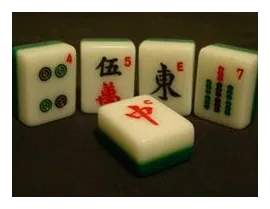
Japanese Mahjong, especially called Riichi Mahjong (??????????, is a very specific remake from Japan of the traditional Chinese Mahjong. It is as close and yet far from Chinese Mahjong as Shôgi (Japanese Chess) can be the same and yet different from original Chess.
Core mechanisms
Key systems that shape the decisions players make.
Read the full game description
Japanese Mahjong, especially called Riichi Mahjong (??????????, is a very specific remake from Japan of the traditional Chinese Mahjong. It is as close and yet far from Chinese Mahjong as Shôgi (Japanese Chess) can be the same and yet different from original Chess. Mahjong was brought to Japan in 1904, but the Riichi form that is used in modern times probably originated from the 1920s. Today, the worldwide famous Mahjong Association officially recognized the complete rules of Riichi Mahjong for Tournaments. The main differences are : 1) The 1-Yaku minimum: In order to win a hand, it can only be validated when your hand has at least one of the Yaku (specific hand combinations) in it. 2) Dora: A specific bonus tiles are indicated by the flipped tile from the dead wall and providing other possible Han bonus. 3) Riichi: When a player is Tenpai (one tile away from having a Mahjong hand, valid or not), he can bet a 1000 points chip to add one Yaku to his hand (thus validating a possible invalid hand). Winning with a Riichi hand allows access to the hidden ura-dora, which is an added dora indicator located underneath the revealed dora tile. 4) Abortive draws: Specific conditions, which ends a hand without winning prior to the drawing of all tiles, aside from the dead wall. 5) Scoring system: Much more complex than in Chinese Mahjong, it is based on hand combinations (Yaku) providing multipliers (Han) that combine with some other circumstantial points like the type of tiles in the hand (Fu) for any 4 han or less. The combination of Han and Fu correspond to a chart (and even an equation) to finally produce the hand's scoring points (Ten). Some other minor elements in the Riichi Mahjong differ from the original Mahjong but are not important enough to be fully mentioned, like the Red 5 tiles (a non-official variant sometimes used which gives bonus like the Dora) or the validation of some Yaku (when the hand must be kept hidden or not, depending on the Japanese region where the game is played).