Overview
At a glance
Is this game right for my group?
ABG editorial scores on a 1–5 scale.
Harder to teach
High replayability
Highly interactive
Scales well
Deep strategy
How it plays
How does it play?
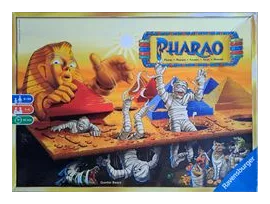
The immensely rich but unfortunately somewhat scatter-brained Pharaoh had, during his life, collected treasures from throughout his kingdom. He decided to hide them in his pyramid to prevent then from being stolen.
Core mechanisms
Key systems that shape the decisions players make.
Read the full game description
The immensely rich but unfortunately somewhat scatter-brained Pharaoh had, during his life, collected treasures from throughout his kingdom. He decided to hide them in his pyramid to prevent then from being stolen. Unfortunately he is no longer sure where he has buried what. With luck you will be able to help him find his treasure again. The player that finds the most of the Pharaoh's treasures and thereby collects the greatest number of search cards is the winner. After chips have placed in the game board, pyramids placed on top and the board spun around a few times in the hopes the players won’t know where treasure chips are located, the first player chooses a treasure card which assigns the number or points that the treasure will be worth would the player find it. The treasure cards have been separated into three piles marked 1, 2 and 3. Once pile 1 is exhausted, game continues with pile 2, etc. Then the player slides a pyramid into an empty space on the board. If no treasure chip is found, the player moves another pyramid. If the chip does not match his card, their turn is over. If the treasure is found, the player keeps the treasure card but the token stays where it is. Mixed in with the treasure cards are event cards as follows: Sandstorm: Turn the board through 180 degrees and take the next pile from the card. Gift: Move to one of the twelve treasures. Each player that has one or more search cards depicting this treasure must give you one of them. Risk: Nominate two treasures that are not currently displayed on the board. Move first to one and then to the other. If you succeed - well done! If you don't then you must give one of your opponents' one of your search cards. Mirage: You draw a search card from your right hand neighbor's collection. If you are able to move to this treasure without making a mistake then you may keep the card. If you do not manage it then you must give your right hand neighbor one of your cards. Desert Poker: A player of you choice must try to find a treasure that you nominate. If he succeeds then he can take one of your search cards. If he fails then you can take one of his. End Game: The Pharaoh is happy because all the treasure has been found. As soon as this (Pile 3 only) card is turned over the game ends and the players total up the points that are shown on their search cards. After each player has found a treasure the board is rotated through 90 degrees in a chosen direction. Once all the search cards from the second pile are used up then pile "3" is used. In this final round all the treasures on the search cards are worth 4 points and anyone who has not yet been particularly successful can, with brains and luck, overtake all the others. When a player finds a treasure chip that is not the one that he was looking for he is out of the game. The remaining players continue. Play continues until all the players are eliminated or the End Game Card is turned over. All the players total up the points that they have showing on the search cards they have collected. The player with the greatest number of points is the winner.