Overview
At a glance
Is this game right for my group?
ABG editorial scores on a 1–5 scale.
Harder to teach
High replayability
Highly interactive
Scales well
Deep strategy
How it plays
How does it play?
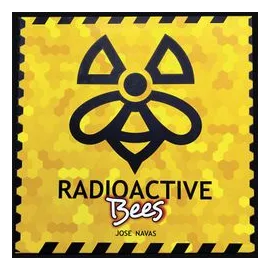
Radioactive Bees is a tile placing strategy game that resembles a post-apocalyptical beehive under construction. The purpose of the game is to place tiles of different shapes to earn points and prevent opponents from using their tiles to earn points for themselves.
Core mechanisms
Key systems that shape the decisions players make.
Area Majority
Compete to have the strongest presence in areas that award control or points.
Tile Placement
Place tiles to build a shared or personal spatial arrangement.
Grid Coverage
Place pieces to cover required cells or patterns on a grid.
Hexagon Grid
Use a hexagonal map where each space connects evenly in six directions.
Read the full game description
Radioactive Bees is a tile placing strategy game that resembles a post-apocalyptical beehive under construction. The purpose of the game is to place tiles of different shapes to earn points and prevent opponents from using their tiles to earn points for themselves. During each turn, players position one of their tiles on the board, keeping within the hive’s pattern. The tiles may be placed in any direction or position. When all the available spaces have been covered up on the board, the game continues on top of the tiles already in play. Each new tile must be placed so that it covers part of at least two unique tiles from the layer below. A tile may not be used to completely cover up a tile of the same shape from the layer below. No part of a new tile may be placed with a gap underneath it. All tile placement options must be exhausted before starting a new layer. If a player still has a tile that fits in an unfinished layer, they must place that tile regardless of whether an opponent has started a new layer. A player may not miss a turn unless none of their tiles can be placed or if they have run out of pieces. In such cases, opponents continue playing until they run out of possible moves, thus ending the round. When the round has ended, players mark every uncovered bee with one ring. Players accumulate points by keeping their bees uncovered and by adding radioactive rings to their bees. The more rings a bee has, the more points it gets at the end of the game. Finally, players remove all tiles from the board and start a new round. The rings that have been placed remain on the tiles for the rest of the game, even if they are covered in a subsequent round. SCORING Players accumulate points in two different ways: 1. During each round when their bees get covered by an opponent’s tile. If one or more of your bees are blocked by an opponent's tile, the targeted bee's current point value is added immediately to your score. If players cover up their own bees, they get no points. 2. At the end of the game, by totalizing the value of the rings adquired on their bees. END OF THE GAME The game ends when, at the end of a round, one or more bees have earned enough radioactive rings to receive radioactive markers and emerge as mutant queens. The player with the most points, after the score for the final round is calculated , wins the game. -description from designer