Overview
At a glance
Is this game right for my group?
ABG editorial scores on a 1–5 scale.
Harder to teach
High replayability
Highly interactive
Scales well
Deep strategy
How it plays
How does it play?
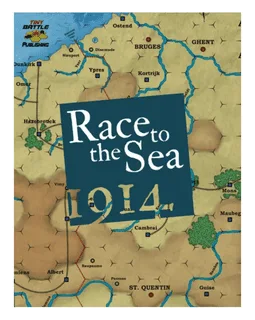
"Race to the Sea 1914" is the feature magazine wargame included in Yaah! #8 by Flying Pig Games.
Core mechanisms
Key systems that shape the decisions players make.
Campaign Card Play
Play cards to command conflicts and carry consequences through a campaign.
Card Play Conflict Resolution
Resolve confrontations by choosing and comparing cards rather than only statistics.
Grid Movement
Move pieces between adjacent spaces on a regular grid.
Events
Triggered events alter the shared state, rules, or available choices.
Hexagon Grid
Use a hexagonal map where each space connects evenly in six directions.
Read the full game description
"Race to the Sea 1914" is the feature magazine wargame included in Yaah! #8 by Flying Pig Games. After the Battle of the Marne was won by the Allied armies in early September 1914, the Germans withdrew to a formidable position north of the Aisne River and entrenched themselves on the high ground. Numerous French efforts to dislodge them failed and the two great hosts stared at each other from their respective trenches. German General Erich von Falkenhayn and French Marshal Joseph Joffre realized that there was much open, exploitable territory to the north of these solidified lines and each prepared to maneuver around the flanks of his opponent. These mutual and simultaneous flanking moves resulted in a series of headlong battles that gradually shifted the forces north toward the French Channel coast. These maneuverings yielded a series of encounter battles at Picardy, Albert, Artois, La Bassee and along the Yser River. But these engagements were ultimately indecisive and the campaign’s final stage was set for the dramatic clash at the end of the “race”, at the ancient textile city of Ypres. The “Race to the Sea” campaign was the last mobile campaign on the western front of the First World War – a last chance for victory. It was a final push to get “home before the leaves fall”. But the resulting murderous battles – culminating in the infamous “Kindermord von Ypern” (the Massacre of the Innocents at Ypres) – were so bloody and indecisive that their effects instead directly lead to the creation of the Western Front trench lines and to a continuation of a war that seemed would never end. The game system is based on the same system used in the game Dead Reckoning by Tiny Battle Publishing. There are no dice, no CRT's, no lists of modifiers and no combat factors. A card-based combat resolution and initiative bidding system drives the action, along with a random event table that provides variety, WWI theme and campaign-specific events. The game includes: One 12" x 18" map 88 counters 36 cards (12 Initiative and 24 Combat Results)