Overview
At a glance
Is this game right for my group?
ABG editorial scores on a 1–5 scale.
Harder to teach
High replayability
Highly interactive
Scales well
Deep strategy
How it plays
How does it play?
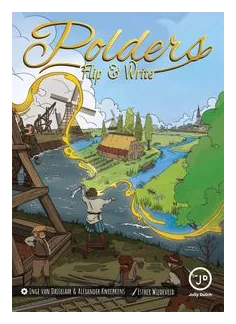
In Polders: Flip & Write you will be a 17th century Dutch investor that invested in the creation of the Dutch polders Beemster, Schermer, Wijde Wormer and Purmer. Flip and Write your way to the best combinations of fields, gardens, mills, farms and manors.
Core mechanisms
Key systems that shape the decisions players make.
Area Majority
Compete to have the strongest presence in areas that award control or points.
Line Drawing
Draw lines to connect, divide, trace, or claim parts of the play area.
End Game Bonuses
Earn additional points for meeting conditions evaluated when the game ends.
Square Grid
Use an orthogonal grid where position and adjacent spaces shape movement or placement.
Read the full game description
In Polders: Flip & Write you will be a 17th century Dutch investor that invested in the creation of the Dutch polders Beemster, Schermer, Wijde Wormer and Purmer. Flip and Write your way to the best combinations of fields, gardens, mills, farms and manors. But be careful! After each time you 'write', you hand your polder to the player on your left. The game is set in the 17th century in the Netherlands, a time when the country was experiencing a massive economic boost and merchants were looking for ways to increase food production. As a result, they came up with massive projects to enclose lakes with dikes and pump out the water with windmills. The resulting low-lying tract of land is known as a polder. One polder was qualified as an UNESCO World Heritage site: the Beemster Polder. The Beemster has a solid dike of 42 kilometers long, was pumped dry with 43 windmills, has its lowest point at 7 meters (23 feet) below sea level, and has a surface of 72 square kilometers (nearly 28 square miles). The land created in this polder, and the three polders created in the following decades, was incredibly fertile and therefore mostly used for farms. But the rich and powerful of the nearby city of Amsterdam also created ‘buitenplaatsen’ (country houses or manors). In the game Polders, the four big polders created in the first half of the 17th century are your playing field. —description from the publisher