Overview
At a glance
Is this game right for my group?
ABG editorial scores on a 1–5 scale.
Harder to teach
High replayability
Highly interactive
Scales well
Deep strategy
How it plays
How does it play?
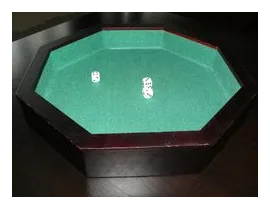
A Pietjesbak (or Pitjesbak, translated: Seedsbox) is an 8 sided wooden box covered with felt. It has a diameter of approximately 38 cm.
Core mechanisms
Key systems that shape the decisions players make.
Read the full game description
A Pietjesbak (or Pitjesbak, translated: Seedsbox) is an 8 sided wooden box covered with felt. It has a diameter of approximately 38 cm. The game is played in the box using 3 regular D6 dice. You also need a piece of chalk for scoring. There are different playing versions of this game. Special houserules/pubrules are common. The most common rules: Each player gets 15 points to start with (or 9 for a short game), marked with chalk on their side of the Pietjesbak. The purpose is to get the highest score within 3 rolls and with that lose all his points. The starting player can roll any/all three dice up to 3 times. Each other player gets as many rolls as the first player, and tries to get a higher score. One counts as 100, 6 counts as 60, the other numbers count as their face value. Special combinations have a higher score. The highest score wins the round and the player can reduce their score by 1, 2 or 3. The different scores (from lowest to highest): 3 numbers that are not one of the special combinations below. The dice are added together. Example: 1,2,6 = 100+2+60 = 162. The winner reduces their score by 1. Zand/Sand, 3 identical numbers. Example: 3,3,3. The higher the better (except: 1,1,1 aka Drie Apen). The winner reduces their score by 2. Soixante-Neuf/Sixty-Nine (4,5,6 = 4+5+60 = 69). The winner reduces their score by 3. Drie Apen/Three Apes (1,1,1 = 100+100+100 = 300, which is unbeatable). With this score you instantly win the game. To summarize (with out-of-sequence ranks in bold-italics): 300 > 69 > triple-six 180 > triple-five 15 > triple-four 12 > triple-three 9 > triple-two 6 > 260 > 220 > 205 > 204 > 203 > 202 > 165 > 164 > 163 > 162 > 125 > ...> 122 > 110 >...> 104 > 70 > 68 >...> 64 > 14 >...> 7 (lowest 2,2,3)