Overview
At a glance
Is this game right for my group?
ABG editorial scores on a 1–5 scale.
Harder to teach
High replayability
Highly interactive
Scales well
Deep strategy
How it plays
How does it play?
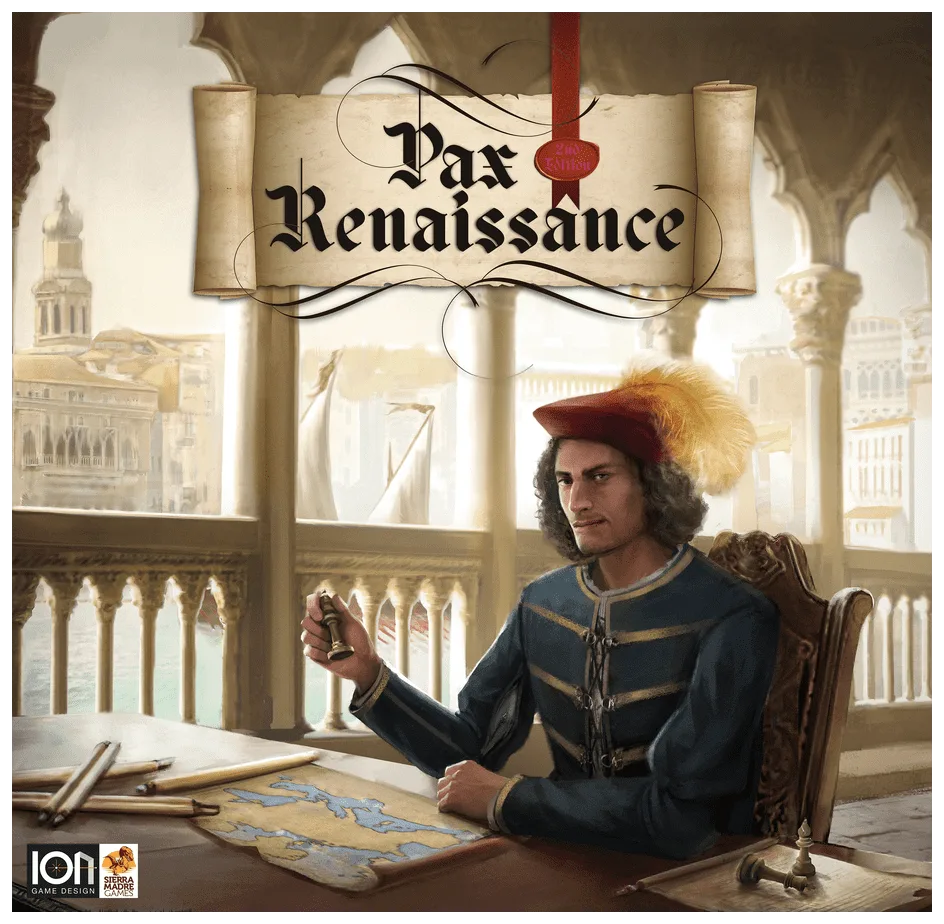
As a Renaissance banker, you will finance kings or republics, sponsor voyages of discovery, join secret cabals, or unleash jihads and inquisitions. Your choices determine whether Europe is elevated into the bright modern era or remains festering in dark feudalism.
Core mechanisms
Key systems that shape the decisions players make.
Action Points
Spend a limited allowance of points across several possible actions each turn.
Auction: Dutch
Bid against other players to determine who receives an item, action, or priority.
Market
Buy and sell through a shared supply whose availability or prices can change.
Open Drafting
Select cards or items from a shared face-up display.
Rising Resource Values
Resources become more valuable when players repeatedly leave them unselected.
Simulation
Model a real or imagined system through detailed cause-and-effect rules.
Read the full game description
As a Renaissance banker, you will finance kings or republics, sponsor voyages of discovery, join secret cabals, or unleash jihads and inquisitions. Your choices determine whether Europe is elevated into the bright modern era or remains festering in dark feudalism. In Pax Renaissance, you have two actions each turn. As in other Pax games, you can acquire cards in a market, sell them out of the game, or play them into your tableau. You can also stimulate the economy by running trade fairs and trading voyages for Oriental goods. A map of Europe with trade routes from Portugal to Crimea is included, and discovering new trade routes can radically alter the importance and wealth of empires, ten of which are in the game. Four victories determine the future course of Western Society: Will it be towards imperialism, trade globalization, religious totalitarianism, or enlightened art and science?