Overview
At a glance
Is this game right for my group?
ABG editorial scores on a 1–5 scale.
Harder to teach
High replayability
Highly interactive
Scales well
Deep strategy
How it plays
How does it play?
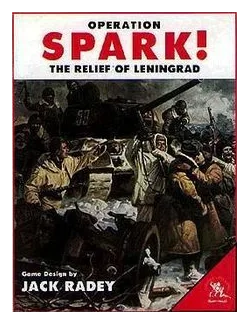
"Operation Spark: The Relief of Leningrad 1943", is a simulation of the Soviet military offensive (Operation Iskra) during World War II, designed to break the German Wehrmacht's Siege of Leningrad.
Core mechanisms
Key systems that shape the decisions players make.
Read the full game description
"Operation Spark: The Relief of Leningrad 1943", is a simulation of the Soviet military offensive (Operation Iskra) during World War II, designed to break the German Wehrmacht's Siege of Leningrad. Planning for the operation began shortly after the failure of the Sinyavino Offensive. The German defeat in the Battle of Stalingrad in late 1942 had weakened the German front. By January 1943, Soviet forces were planning or conducting offensive operations across the entire German-Soviet front, especially in southern Russia, Iskra being the northern part of the wider Soviet 1942–1943 winter counter offensive The city of Leningrad, second largest in the USSR, had been cut off by the Germans since September 8, 1941. Now, sixteen months later, the Soviets were about to make their third attempt to relieve the city. The first attack in January 1942 had led to the mauling of the 2nd Shock Army in the swamps to the south, and a second failure between Sinyavino and Mga in the summer of 1942 had also taken heavy casualties, although it had completely derailed von Manstein's planned assault on the city itself. Now in January of 1943 the Red Army was set to try again. Uses the same game system rules as the following Clash of Arms Games wargames, the award winning Black Sea Black Death, Aachen and Borodino '41. The game is set in a frozen peat bog, bordered by a frozen lake and a frozen river, is a slugging match. German fortified lines cut through the snow filled woods and encircle the worker's settlements and the critical Sinyabino Heights. The Red Army appears for the most part in regiment sized units of riflemen, artillery and heavy mortars, backed up by battalions of tanks (half of them light T-60s), skiers, marines, engineers, as well as by naval artillery, air power, and a few odd units like aerosans and observation balloons. The Germans have most of their units in infantry and artillery battalions, backed up by companies of Tiger and Pzkw.III tanks, deadly 88mm flak guns, and STUG IIIs. The Germans also field everything from a battalion of Spanish fascists to a railroad battery. They also field battalions of heavy artillery, nebelwerfers, and captured French coastal guns, as well as mountain troops, jaegers, the SS Polizei Division, and several overstrength independent regiments plus their Tiger tanks (here seen in their debut performance). Game Scale: Turn: Impulses = 4-5 hours, 5-6 impulses per day Hex: 880 yards / 804 meters Units: Company to Regiment Game Inventory: One 22 x 34" full-color mapsheets Three dual-side printed countersheets (2 combat, 1 markers - 620 1/2" counters) One 32-page Operation Spark rules booklet Six Player Aid cards Two 10-sided dice Players: 1 or more Playing Time: 2-20 hours Complexity: Medium Solitaire Suitability: Moderate