Overview
At a glance
Is this game right for my group?
ABG editorial scores on a 1–5 scale.
Harder to teach
High replayability
Highly interactive
Scales well
Deep strategy
How it plays
How does it play?
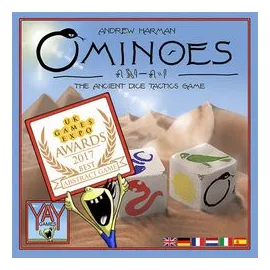
Winner of the UK GAMES EXPO Award for BEST ABSTRACT GAME 2017 1864, Ominus Valley, Egypt — a hoard of 6,000-year-old game cubes is found. No one knows how to play this mysterious game — until now when this ancient game is reborn as Ominoes.
Core mechanisms
Key systems that shape the decisions players make.
Grid Movement
Move pieces between adjacent spaces on a regular grid.
Dice Rolling
Roll dice to introduce uncertainty into actions, production, movement, or resolution.
Push Your Luck
Choose whether to secure current gains or risk them for a larger reward.
Die Icon Resolution
Interpret rolled icons to determine which actions or effects occur.
Pattern Recognition
Identify recurring visual, spatial, or logical arrangements.
Square Grid
Use an orthogonal grid where position and adjacent spaces shape movement or placement.
Read the full game description
Winner of the UK GAMES EXPO Award for BEST ABSTRACT GAME 2017 1864, Ominus Valley, Egypt — a hoard of 6,000-year-old game cubes is found. No one knows how to play this mysterious game — until now when this ancient game is reborn as Ominoes. In this abstract strategy/tactical game, 2-4 players want to collect their favored gods — Horus, Ra, Apep, and Khepri — in groups to earn points. They do this by rolling custom dice that both determine actions and are placed on the game board to count as a piece of the player's color. On a turn, the active player does the following: Roll: Take a die and roll it. Move: Move a die on the board that matches the rolled color exactly three spaces. Place: Placing the die just rolled on the board, possibly scoring a group. The dice have four faces matching the players colors, with unused colors in a two- or three-player game being scorable by anyone. The other two faces — "Yay-Ra" and "Ominotep" — allow the player to move or reroll any die, respectively, and they count as wild once on the board. Groups of four (or more) dice of a color are scored immediately and give their player points equal to their number. The first player to 13 points (or 21 points in a two-player game)wins! Quick to learn, easy to play but with layers of light tactics. Ominoes is 15 minutes of play.