Overview
At a glance
Is this game right for my group?
ABG editorial scores on a 1–5 scale.
Harder to teach
High replayability
Highly interactive
Scales well
Deep strategy
How it plays
How does it play?
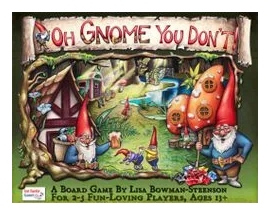
In Oh Gnome You Don't! players are the gnomes promised in the title, trying to get their hands on as many gems as possible, whether through sales at various businesses or brawls with their fellow gnomes.
Core mechanisms
Key systems that shape the decisions players make.
Read the full game description
In Oh Gnome You Don't! players are the gnomes promised in the title, trying to get their hands on as many gems as possible, whether through sales at various businesses or brawls with their fellow gnomes. Each player starts with a hand of two cards from a deck of 104 and (optionally) ten Brawl cards, with the gnomes placed at the start of the track. On a turn, a player rolls the die, then moves along the track or into a business (exact roll not needed). If on the trail, a player plays one card, then draws one card. Green cards give you items to sell later at businesses; purple cards provide an immediate action, such as additional movement, gem theft, missed turns, and so on; red cards allow you to attack another player or defend against attacks. If in a business, the player sells as many green cards as desired, collecting gems for the goods sold. If being used, Brawl cards can be played when two gnomes land in the same space. If they agree to brawl, each player chooses one card from his personal deck, then simultaneously reveal them. The player with the higher card wins the difference between the cards in gems from the loser. Players score extra gems or are penalized gems based on their order of finish, with any remaining green cards on the table selling for only half their value. The player with the most points wins.