Overview
At a glance
Is this game right for my group?
ABG editorial scores on a 1–5 scale.
Harder to teach
High replayability
Low interaction
Scales well
Deep strategy
How it plays
How does it play?
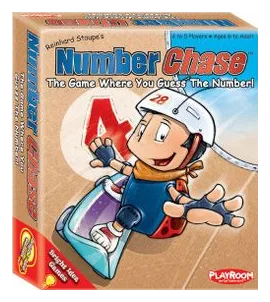
In Number Chase, a.k.a. Zahlenraten, players to try to guess the number being thought of by one of their fellow players — and they use deduction (and a dose of luck) to do so.
Read the full game description
In Number Chase, a.k.a. Zahlenraten, players to try to guess the number being thought of by one of their fellow players — and they use deduction (and a dose of luck) to do so. To set up the game, lay out the cards numbered 1-50 in five rows. Choose a player to be the first "writer", and this player selects one of these number cards secretly. The other players now take turns trying to guess this number. To guess, a player places their finger on a card. If the guess is correct, they claim the card as a point and become the new writer for the next round; if it's not correct, then they turn that number cards face down to reveal a question, such as "Is the hidden number even or odd?" or "Is the hidden number between 1 and 15?" The writer must answer this question truthfully before the next player guesses, giving everyone more information about what the number is. When you start the next round, flip all the number cards face up once again. Claimed cards are out of play, so those numbers cannot be called again. Whoever first collects three cards wins!