Overview
At a glance
Is this game right for my group?
ABG editorial scores on a 1–5 scale.
Harder to teach
High replayability
Highly interactive
Scales well
Deep strategy
How it plays
How does it play?
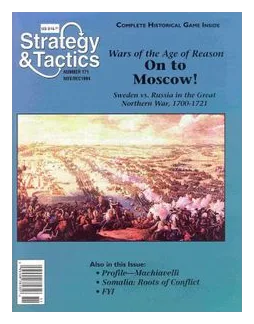
ON TO MOSCOW , Sweden vs Russia in the great northern war, 1700-1721. ON TO MOSCOW is a simulation of the climactic Russian campaign of the Great Northern War (1700-172 1).
Core mechanisms
Key systems that shape the decisions players make.
Read the full game description
ON TO MOSCOW , Sweden vs Russia in the great northern war, 1700-1721. ON TO MOSCOW is a simulation of the climactic Russian campaign of the Great Northern War (1700-172 1). Charles XII, King of Sweden, personally led an invasion deep into Tsar Peter the Great’s realm. The Russians engaged in a successful defensive campaign which culminated in the epic battle of Poltava. As a result, Sweden’s mastery of the north was forever smashed, and Russia emerged as a great European power. In ON TO MOSCOW, one player controls the Swedish side; the other controls the Russian side. The objective is to gain control of as many Fortress cities as possible and destroy the enemy’s military power. Each side has a number of military units and leaders with which to attack enemy forces and gain control of Fortresses. The rules consist of a Standard Game that gives a relatively simple but historically valid game, and an Advanced Game providing a more complete historical simulation. Players who want to learn the game quickly should just read the GENERAL RULE beneath each major rules section, and then follow the specific procedures within each section as the need arises during the course of play.