ABG All Board Games
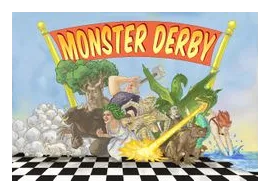
Monster Derby box art
Rich game profile

Monster Derby

A race game between eight fantasy monsters selected at random from a deck of 25 (e.g., medusa, cyclops, vampire, zombie, centaur, dragon, griffin, djinni). Players get secret agendas, listing the order they want the monsters to finish according to colored mover bases for the card...

Players

2-8

Time

20-45

Age

10+

Weight

2.29

Rating

6.18

Should this hit the table?

Quick read before the metadata.

Monster Derby has a high level of direct confrontation and strategic depth in confrontation. Players need to frequently pay attention to and react to others' strategies and turns. However, there is less emphasis on cooperation in the game.

Teach 2.3

Teaching signal

Replay 4.0

High replayability

Interaction 3.7

Highly interactive

Scaling 4.0

Scales well

Strategy 4.5

Deep strategy

Control 3.0

Luck-sensitive

Table feel

Monster Derby has a high level of direct confrontation and strategic depth in confrontation. Players need to frequently pay attention to and react to others' strategies and turns. However, there is less emphasis on cooperation in the game.

Replay value

Monster Derby offers a high level of variability in each playthrough with a diverse gameboard and multiple paths to victory. The presence of expansions adds new content and gameplay elements, enhancing replay value. The game provides deep strategic possibilities and room for players to improve their tactics over time. The player interaction score is moderate. The game scales well with different numbers of players without compromising its appeal or balance. While it may take some time to learn, the game offers a good balance between easiness and depth. Overall, Monster Derby has a strong replayability score of 7.9.

Luck profile

Monster Derby has a moderate influence of luck. Random elements, such as dice rolls and card draws, have a notable but not exclusive impact on the game outcome. While players have some ability to mitigate the effects of luck through strategic decisions, luck still plays a significant role. The game relies on a balanced mix of luck and strategy, making it suitable for players who enjoy a combination of chance and skill.

Overview

What ABG knows about this game

A race game between eight fantasy monsters selected at random from a deck of 25 (e.g., medusa, cyclops, vampire, zombie, centaur, dragon, griffin, djinni). Players get secret agendas, listing the order they want the monsters to finish according to colored mover bases for the cards. On each player's turn, they move a monster toward the finish line. All monsters move forward a die roll but if you are moving a monster that doesn't score high for you, you can waste its movement by zig-zagging or wandering into non-native terrain. Each monster must move once per round, so even those that no one likes will get moved (and present bluffing opportunities for clever players). A monster can attack once per move -- a great way to slow down a monster you don't like is to beat it unconscious. Each monster is rated for the number of custom attack dice (marked with just 0s and 1s) they throw to find damage. Monsters also have special powers, some active all the time and others that only kick in when a custom "wacky die" shows sword or shield icons. The game includes reversible mapboards with different terrain patterns (brush, rock, water, etc.) to create a wide variety of maps. Monsters move into their native terrains as if they were blank squares and get a defensive bonus as well. Some monsters can fly, ignoring terrain except where they land. The race ends when three monsters have crossed the finish line. Everybody counts up the points listed on their secret agendas for those three monsters. Example: the dragon, doppleganger, and hare finish in that order. My agenda says dragon 8, doppleganger 5, and hare 3 so I score 16 points; the monsters I had listed for positions 7, 6, 4, 2 and 1 didn't finish. Note that this description is for the 2014 edition of the game. The original used regular dice, counters rather than cards, scored all eight finishers and had players set their own agendas (both of which stretched out the game considerably).

Media

Images and visual references

Images, galleries, and videos are grouped here so the page feels visual before every asset is fully hosted.

No media imported yet.

Editions

Versions and regional releases

Edition Year Language Publisher / Region
No editions imported yet.

Files and documents

Rules, aids, translations

No files imported yet.

Credits

People and publishers

Designers

1
Jeff Siadek

Artists

3
Jason Siadek Gary Tharler Neal von Flue

Publishers

2
Gamesmiths Gorilla Games

Linked items

Graph expansion queue

Related games and expansions help build a connected catalog around every title.

No linked items imported yet.