Table feel
Mod X has a high level of direct confrontation and strategic depth in confrontation. Players need to be aware of and react to each other's strategies frequently. However, there is less emphasis on cooperation in the game.
Players
2-4
Time
?-?
Age
15+
Weight
1.67
Rating
6.96
Teaching signal
High replayability
Highly interactive
Scales well
Deep strategy
More strategic control
Mod X has a high level of direct confrontation and strategic depth in confrontation. Players need to be aware of and react to each other's strategies frequently. However, there is less emphasis on cooperation in the game.
mod x offers a high degree of variability with its gameboard, multiple paths to victory, and variable setups. The presence of expansions adds new content and gameplay elements, enhancing replay value. The game provides deep strategic possibilities and allows players to improve their strategies over time. The player interaction score is moderate. mod x scales well with different numbers of players without compromising its appeal or balance. While it may take some time to learn, the game offers a good balance between easiness and depth. Overall, mod x has a strong replayability score of 7.95 out of 10.
Mod X has a moderate level of luck involved in the game. Random elements, such as dice rolls or card draws, have a notable but not exclusive impact on the game outcome. However, players have substantial ability to mitigate the effects of randomness through strategic decisions and planning. The game outcome is primarily determined by player strategy and decisions, with luck playing a minor role. Overall, Mod X strikes a good balance between luck and strategy.
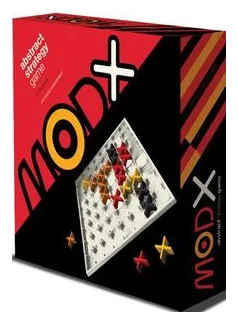
In the abstract strategy game MOD X, each player has 14 game pieces and 18 score markers, with the goal being to reach an established number of points (determined by the number of players). Players take turns placing a game piece on the board and trying to create scoring patterns – an "X", a "+", or a line, with each pattern requiring five pieces – while simultaneously trying to block their opponents from scoring with these same patterns. After creating a successful pattern, a player places score markers on the board marking these spaces. Players can lose their score markers, however, if opponents create scoring patterns over these score markers on a later turn. The game ends when one player reaches the established number of points (and wins) or a player runs out of pieces; in this latter case the player with the most points wins.
| Edition | Year | Language | Publisher / Region |
|---|---|---|---|
| No editions imported yet. | |||
No files imported yet.
No linked items imported yet.