Overview
At a glance
Is this game right for my group?
ABG editorial scores on a 1–5 scale.
Harder to teach
High replayability
Highly interactive
Scales well
Deep strategy
How it plays
How does it play?
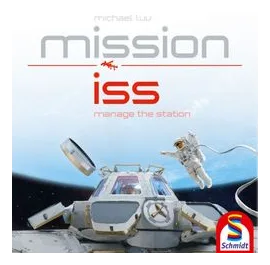
The International Space Station (ISS) is a joint project in which sixteen countries are currently involved. The ISS is a symbol of what people can achieve by working together.
Core mechanisms
Key systems that shape the decisions players make.
Action Drafting
Choose actions from a shared supply before opponents can claim them.
Cooperative Game
Players coordinate their actions toward a shared objective and win or lose together.
Action/Event
Cards can provide player actions, trigger events, or force a choice between them.
Area Movement
Move pieces between connected regions rather than along individual spaces.
Command Cards
Use cards to issue orders and determine which units or actions can activate.
Read the full game description
The International Space Station (ISS) is a joint project in which sixteen countries are currently involved. The ISS is a symbol of what people can achieve by working together. Boundaries that seem so important on Earth take a back seat on the space station; what matters is a perfectly coordinated collaboration between the astronauts. Mission ISS begins in 1998 when the first module of the ISS was built. From your control center, you give instructions to the astronauts in space. At first only a few crew members are on the station, but over time you bring more astronauts to the station to add new modules, carry out various research assignments, or just drift in weightlessness. As on the real space station, the co-operation between the players and the co-ordination of the astronauts determine the success of the ISS mission. Only together will you be able to master the challenge of space. In more detail, the mechanism at the heart of the game requires deep co-operative play. To give instructions to astronauts, you combine two command cards: one of yours and one of your teammates. After you have performed the command effects, you place both cards on your own discard pile, which means that your turns always have an impact on the options of the other players. When you run out of cards, you take all cards from your discard pile to re-fill your display — but doing so brings the end of the game closer. Up to six astronauts can be on the ISS. Each astronaut stands on a base with adjustable values for three types of abilities: drift to move, carry out researches, and add new modules. Train the astronauts to improve their abilities so that they can manage all of the challenges on the ISS.