Overview
At a glance
Is this game right for my group?
ABG editorial scores on a 1–5 scale.
Harder to teach
High replayability
Highly interactive
Scales well
Deep strategy
How it plays
How does it play?
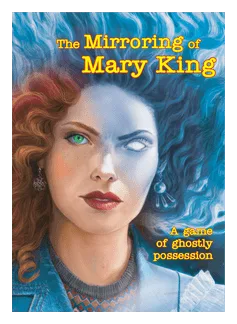
The Mirroring of Mary King is a two-player game in which one person is a mortal contemporary woman named Mary King and the other player is the ghost of Mary’s long dead ancestor, a 17th century Scottish merchant burgess of the same name.
Core mechanisms
Key systems that shape the decisions players make.
Card Play Conflict Resolution
Resolve confrontations by choosing and comparing cards rather than only statistics.
Hand Management
Time and sequence a limited hand of cards to preserve future options.
Advantage Token
A transferable advantage changes ties, priority, or the strength of an action.
Asymmetric Roles
Different roles know different information and contribute in different ways.
Zone of Control
Restrict or influence movement through areas controlled by nearby pieces.
Turn Order: Role Order
Determine or change the order in which players take their turns.
Read the full game description
The Mirroring of Mary King is a two-player game in which one person is a mortal contemporary woman named Mary King and the other player is the ghost of Mary’s long dead ancestor, a 17th century Scottish merchant burgess of the same name. While on a week’s holiday in Edinburgh, Mary visits Mary King’s Close where her presence attracts the spirit of her long dead ancestor, now a hungry ghost that wants to live again in Mary’s body. The two Marys engage in a battle for control of the living Mary’s mortal body. Players use control cards and power cards to exert their influence on Mary King’s psyche, represented by 12 tiles arranged in a 4 x 3 grid. These tiles are flipped back and forth throughout the game as the players gain and lose control of them. The game progresses over five days, starting on Monday and ending on Friday. Each player gets one turn each day, with the ghost player always going first. As the week progresses, the mortal and the ghost become more exhausted and more desperate: the number of control cards each may play decreases and the number of ideas they may pursue increases. At the end of each player’s turn, both players suffer penalties based on the tiles of Mary that their opponent controls. A player may immediately win the game by completing their image of Mary using the 12 tiles, or if their opponent runs out of cards. If neither player completes their image of Mary by the end of Friday, the winner is determined by a scoring system based on their remaining cards and their control of Mary. —description from the publisher