Overview
At a glance
Is this game right for my group?
ABG editorial scores on a 1–5 scale.
Harder to teach
High replayability
Highly interactive
Scales well
Deep strategy
How it plays
How does it play?
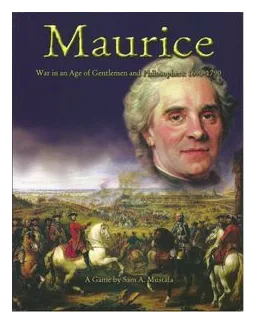
"Maurice" is a delightful combination of tabletop miniatures rules for historical and fictional battles, a limitless campaign system that requires virtually no math or paperwork, and a role-playing game in which the “characters” are officers, units, and armies, whose personalities you create, and whose fates you manage from battle to battle across wars and decades. The game play is driven by the action cards, which are used to activate forces and to modify those actions.
Core mechanisms
Key systems that shape the decisions players make.
Campaign Card Play
Play cards to command conflicts and carry consequences through a campaign.
Dice Rolling
Roll dice to introduce uncertainty into actions, production, movement, or resolution.
Action/Event
Cards can provide player actions, trigger events, or force a choice between them.
Line of Sight
Visibility between pieces determines valid targets, movement, or effects.
Events
Triggered events alter the shared state, rules, or available choices.
Read the full game description
"Maurice" is a delightful combination of tabletop miniatures rules for historical and fictional battles, a limitless campaign system that requires virtually no math or paperwork, and a role-playing game in which the “characters” are officers, units, and armies, whose personalities you create, and whose fates you manage from battle to battle across wars and decades. The game play is driven by the action cards, which are used to activate forces and to modify those actions. Each card has the potential to do more than one thing, but can only ever be used for a single thing at any given time. The game is played in alternating rounds. The active player first chooses whether or not volleys will be fired by both sides. Then he decides whether to play a card for its event, or activate a group of units to march, rally, charge, or bombard. To activate a force a number of cards need to be discarded for their "span" number based on the distance from the commander to the force. The action also determines how many new cards may be drawn, the more vigorous action the fewer cards. Or he could also choose to pass and draw more cards. A group of units depends on their physical proximity, type, and formation. An additional card may be played to modify an action. The passive player might have interrupt cards that enable him to inject complications into the active player’s action. The game continues until one side’s army morale breaks. If neither side’s army morale breaks before the game runs out of cards, then night has fallen without a decisive victory.