Overview
At a glance
Is this game right for my group?
ABG editorial scores on a 1–5 scale.
Harder to teach
High replayability
Highly interactive
Scales well
Deep strategy
How it plays
How does it play?
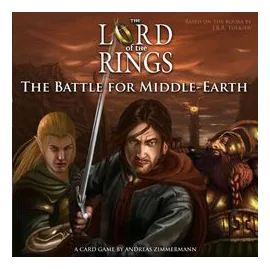
The players battle on the side of Aragorn, Gandalf, Gimli, Legolas, and other companions against the foes of Mordor. Three enemy cards always lie on the table in The Lord of the Rings: The Battle for Middle-earth Card Game.
Core mechanisms
Key systems that shape the decisions players make.
Deck Construction
Build a deck before play by selecting cards under defined construction rules.
Open Drafting
Select cards or items from a shared face-up display.
Hand Management
Time and sequence a limited hand of cards to preserve future options.
Scenario Campaign
Play linked or standalone scenarios with their own setup, objectives, and consequences.
Read the full game description
The players battle on the side of Aragorn, Gandalf, Gimli, Legolas, and other companions against the foes of Mordor. Three enemy cards always lie on the table in The Lord of the Rings: The Battle for Middle-earth Card Game. Each enemy card shows a combination of one (e.g. Orc patrol) to four (e.g. Balrog) symbols, with six different symbols total in the game: sword, axe, spear, bow, fist, and shield. The symbols are not evenly distributed; some are associated with magic, and thus rarer than those associated with mundane weaponry. In order to beat the enemies, the players collect "fellowships" (groups) of companion cards (which also show some subset of the six symbols) in front of them. Once the symbols of a group match one or more enemy cards, the player can send this group to battle to win them. The group is then discarded. On their turn a player can either: Play one companion card to one of their groups and, if possible, attack. Start a new group and, if possible, attack. Draw one card from the deck. If it's a Mordor card, it is placed on the table and the card draw repeated; this continues until a companion is drawn, which is added to the player's hand. When the third Mordor card hits the table, all players suffer a counterattack and lose a card from their hand, a card from one of their groups, or an already vanquished enemy, depending on the text of the Mordor card. Then one of the enemies is discarded, and play continues with the triggering player drawing another card from the deck. When no enemies remain, the game ends. Each enemy card is worth 1-10 victory points, and the player with the most points wins.