Overview
At a glance
Is this game right for my group?
ABG editorial scores on a 1–5 scale.
Harder to teach
High replayability
Highly interactive
Scales well
Deep strategy
How it plays
How does it play?
US-edition Creator (original version): Erik Nielsen Publisher: Endless Games From Publisher Website: 4 Cards... 1 Pair...
Core mechanisms
Key systems that shape the decisions players make.
Hidden Roles
Players conceal team, loyalty, or identity information from one another.
Pattern Recognition
Identify recurring visual, spatial, or logical arrangements.
Team-Based Game
Players compete in fixed teams and coordinate toward a shared team result.
Voting
Players collectively approve, reject, or select an outcome through votes.
Targeted Clues
Give clues intended for a particular player, word, or hidden target.
Read the full game description
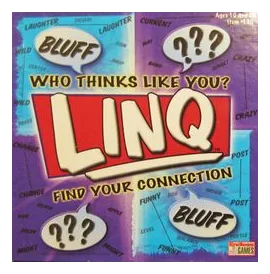
US-edition Creator (original version): Erik Nielsen Publisher: Endless Games From Publisher Website: 4 Cards... 1 Pair... 100 reasons why you SHOULD be right. It's not a word game. It's not a strategy game. It's not a bluffing game, yet all three of these elements are combined in this uniquely simple, excitingly fun, and extremely addictive game: Linq. The object of the game is to guess which two players are the Linq. If you are the Linq, you must think like your partner, and connect with them. The only problem is... You don't know who your partner is! German edition artwork: Sebastian Wagner editor: Andrea Meyer publisher: BeWitched-Spiele game length: ca. 45 minutes Linq combines bluff elements with associative gaming. 4-8 players ages 10 and up try to find their ever changing partners by associating freely to their LINQ-words. An intuitive scoring mechanism shows who was best able to linq with the others in the end. The game contains 58 card pairs with nearly 700 words, 4 question marks, wooden pieces for counting points, a 12-sided die, and the rulebook. French edition artwork: Pierre Lechevalier (aka Piero) publisher: In Ludo Veritas Two spies have to meet each other. All they have in common is a password. All the others players are counterspies triyng to identify and confuse them. The game contains 2 * 50 spy cards with 10 words each (500 different passwords ), 10 counterspy cards, counters, rulebook