Overview
At a glance
Is this game right for my group?
ABG editorial scores on a 1–5 scale.
Harder to teach
High replayability
Highly interactive
Scales well
Deep strategy
How it plays
How does it play?
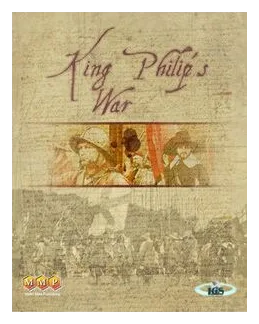
International Game Series game from Multi-Man Publishing. King Philip’s War, is about an all but forgotten New England Indian Uprising that nearly brought the Puritans to their knees.
Core mechanisms
Key systems that shape the decisions players make.
Read the full game description
International Game Series game from Multi-Man Publishing. King Philip’s War, is about an all but forgotten New England Indian Uprising that nearly brought the Puritans to their knees. In the end, over 6000 Indians were slain or captured and sold into slavery. Over 2600 Colonials were captured or killed. In the end King Philip (The Wampanoag sachem, Metacomet) himself was ambushed, beheaded, and quartered. King Philip's hands were sent to the authorities in Plymouth as proof of his demise. Countless Indian villages had been burned; twelve Colonial settlements were completely destroyed and six more heavily damaged. Boston itself very nearly came under attack. In all, 1200 homes were burned, 8000 head of cattle lost, and vast stores of food destroyed. Some sources claim one soldier in ten on both sides was either injured or killed. The game's treatment of this broad conflict is simplified. Only a handful of key settlements are named for historical interest while rivers and settlements are placed not so much for geographic and historic accuracy but for ease of play. The forces involved are also necessarily reduced to create a simpler, quicker game. But, taking these factors into account, King Philip’s War is as faithful a historical reproduction of the conflict as any quick and simple board game can be. Moreover, KPW’s massive destruction, ongoing tension, along with its magnificent art, its singular system of alliances and its unique combat effects die make the game delicious to look at and a real treat to play. Only twelve pages of rules and map that stretches from the Hudson to Cape Cod and from the Merrimack River to Long Island Sound. Game Scale: Game Turn: Approximately 2-3 months Map: Point-to-Point movement Units: Game Inventory: One 22 x 34" full color map Two dual-side printed countersheet (176 5/8" counters) One 20-page King Philip's War rulebook Two dual-side printed players aid cards Two 6-sided die One 6-sided special event die One 8.5 x 6 single-side printed Errata & Clarifications page Solitaire Playability: High Complexity Level: Low Players: 2 or more Playing Time: 1.5 to 3 hours