Overview
At a glance
Is this game right for my group?
ABG editorial scores on a 1–5 scale.
Highly interactive
How it plays
How does it play?
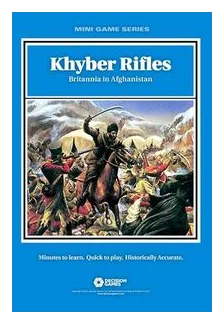
From DecisionGames.com: "Britannia in Afghanistan In 1842 Afghan rebels destroyed a British army as it tried to fight its way from Kabul to the safety of the Khyber Pass.
Core mechanisms
Key systems that shape the decisions players make.
Area Majority
Compete to have the strongest presence in areas that award control or points.
Campaign Card Play
Play cards to command conflicts and carry consequences through a campaign.
Tile Placement
Place tiles to build a shared or personal spatial arrangement.
Point-to-Point Movement
Move along explicit connections between named locations or nodes.
Read the full game description
From DecisionGames.com: "Britannia in Afghanistan In 1842 Afghan rebels destroyed a British army as it tried to fight its way from Kabul to the safety of the Khyber Pass. The British launched an expedition to avenge that defeat, and that led to another campaign in Central Asia’s Great Game. Khyber Rifles is a two-player game of that fateful year in Afghanistan. One player commands British forces, including the regiments and battalions forming the armies of Gens. Nott, Pollock and Elphinstone. The other player controls various Afghan tribal contingents, led by Akbar Khan. The point-to-point map covers eastern Afghanistan and India’s Northwest Frontier area, including the famous Khyber Pass. Khyber Rifles is part of the Hand of Destiny mini-game series. Each player has a unique deck of Campaign Cards. They generate movement abilities, combat bonuses and historical events. Accessing the right card at the right time lets the player concentrate forces to win that great victory against all odds—or perhaps go down to inglorious defeat. Some of the cards include: Ambush, Jirga Loya, Mad Dash and Relief Force. Combat is resolved via a quasi-tactical procedure. There are special rules for: elite British units, fanatic Afghan Ghazis, camp followers, Shah Shujah’s army, and irregular units such as Broadfoot’s Pioneers.