Overview
At a glance
Is this game right for my group?
ABG editorial scores on a 1–5 scale.
Harder to teach
High replayability
Highly interactive
Scales well
Deep strategy
How it plays
How does it play?
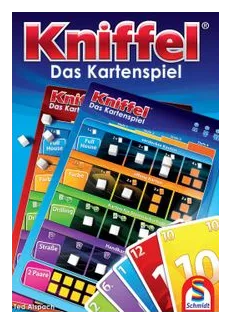
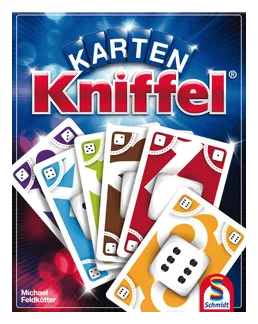
As might be obvious from the title, Karten Kniffel recreates Kniffel (a.k.a. Yahtzee) as a card game.
Core mechanisms
Key systems that shape the decisions players make.
Paper-and-Pencil
Record choices and results directly on a personal sheet.
Hand Management
Time and sequence a limited hand of cards to preserve future options.
Set Collection
Gather related items that become more valuable when scored together.
Score-and-Reset Game
Score repeated rounds or hands, then reset the play state and continue.
Read the full game description
As might be obvious from the title, Karten Kniffel recreates Kniffel (a.k.a. Yahtzee) as a card game. The goal of the game remains the same: Create valuable combinations shown on the scoring sheet and collect more points than everyone else to win. The deck consists of 108 cards, with the numbers 1-6 each appearing 18 times. Each player starts with a hand of five cards. On a turn, a player has two choices: Discard 0-5 cards from your hand, then draw that many cards plus one from the deck. You can't have more than ten cards in hand. Play five cards from hand, record your points on the score sheet, then refill your hand to five cards. In more detail, to score, you lay down five cards and score for one of the combinations on the score sheet: number of 1s, 2s, etc.; three- or four-of-a-kind; full house; small or large straight; Kniffel; etc. Write the score in the left-hand box of the appropriate line. You also lose 2 points for each other card in your hand, so note these penalty points in the right-hand box. As soon as one player scores in all of the lines on his score sheet, players complete the round so that everyone has the same number of turns, then they tally their scores and subtract their penalties. Whoever has the highest score wins.