Overview
At a glance
Is this game right for my group?
ABG editorial scores on a 1–5 scale.
Harder to teach
High replayability
Highly interactive
Scales well
Deep strategy
How it plays
How does it play?
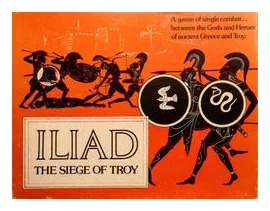
"Iliad: The Siege of Troy" is a wargame of single combat...between the Gods and Heroes of ancient Greece and Troy. To the mundane scholars of academe, the Trojan War was fought for control of the ancient Black Sea trade routes.
Core mechanisms
Key systems that shape the decisions players make.
Grid Movement
Move pieces between adjacent spaces on a regular grid.
Dice Rolling
Roll dice to introduce uncertainty into actions, production, movement, or resolution.
Movement Points
Spend a movement allowance across spaces with different costs.
Events
Triggered events alter the shared state, rules, or available choices.
Hexagon Grid
Use a hexagonal map where each space connects evenly in six directions.
Read the full game description
"Iliad: The Siege of Troy" is a wargame of single combat...between the Gods and Heroes of ancient Greece and Troy. To the mundane scholars of academe, the Trojan War was fought for control of the ancient Black Sea trade routes. To the Romantic, it was fought over Helen of Troy, 'the face that launched a thousand ships and burned the topless towers of Ilium.' Whatever the cause, romantic or commercial, the war raged ten long years and involved the greatest warriors of that ancient age. Behind them stood the Olympian gods who, although forbidden by Zeus from intervening decisively, nevertheless gave what help they could to the side they favored. The Iliad is a fast-moving game of the entire ten-year war which has formed the basis for Homer's epic Iliad. Features include: Every important Greek and Trojan hero is individually represented Heroes face each other in single combat as they vie for superiority Olympian gods may receive appeals and aid their chosen heroes Special rules cover the quarrel between Agamemnon and Achilles: if the quarrel is set aside, Achilles joins the battle, much to the dismay of the Trojans. Outside references: "Players Notes" by S. List in Fire & Movement No. 15, Jan-Feb 1979 Reviewed by Tony Bath in Slingshot 86/28.