Overview
At a glance
Is this game right for my group?
ABG editorial scores on a 1–5 scale.
Harder to teach
High replayability
Highly interactive
Scales well
Deep strategy
How it plays
How does it play?
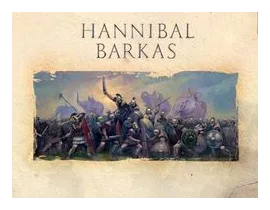
Players participate in the Second Punic War as either Carthage or Rome. Mechanics are based on a card driven system.
Core mechanisms
Key systems that shape the decisions players make.
Read the full game description
Players participate in the Second Punic War as either Carthage or Rome. Mechanics are based on a card driven system. Hannibal Barkas contains military, political and economic elements that emulate ruling an ancient nation. Official release date of the game in Poland is October 2007. Initially, the game will be available only in a Polish version. Game mechanic is card driven - each card can be played in four ways: .as Talents of gold .as Initiative Points (those are needed for army activation, politics and other actions) .as Global events .as interrupt effects played at any time. The game was designed as a dynamic, decision-dependent, exciting strategy. Main features: - Great playability - Simplicity of rules, and yet with many strategic options - Variety of cards that can be played in different ways Aside from commanding armies, there are other aspects of the game that shouldn't be neglected. Minor nations such as Syracusae, Macedonia, Massilia or Numidia can become allies, and strengthen Rome or Carthage with additional cards, gold and armies. Another important aspect of the game is economy. Gold is needed for recruitment of new armies, keeping existing ones in play, diplomacy, and taking opportunities that cards present. Box contents: - rulebook - board - 280 cards (events, cities and leaders) for 6 nations. Each nation has its own deck. - 400 tokens - 5 dice