Overview
At a glance
Is this game right for my group?
ABG editorial scores on a 1–5 scale.
Harder to teach
High replayability
Highly interactive
Scales well
Deep strategy
How it plays
How does it play?
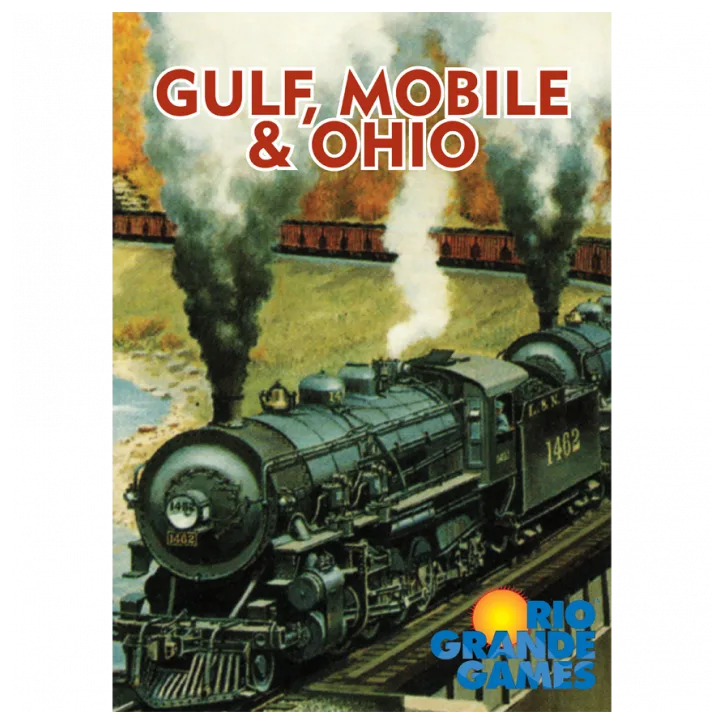
In Gulf, Mobile & Ohio, the third entry in Winsome Games's Historic Railroads System, players build railroads in the South that existed between 1830-1860, with the game board featuring cities from Richmond to New Orleans, and from Memphis to Savannah.
Core mechanisms
Key systems that shape the decisions players make.
Auction/Bidding
Bid against other players to determine who receives an item, action, or priority.
Stock Holding
Acquire shares whose value depends on companies, assets, or player actions.
Connections
Create meaningful links between locations, pieces, or concepts.
Income
Receive recurring resources according to your position, assets, or development.
Hexagon Grid
Use a hexagonal map where each space connects evenly in six directions.
Read the full game description
In Gulf, Mobile & Ohio, the third entry in Winsome Games's Historic Railroads System, players build railroads in the South that existed between 1830-1860, with the game board featuring cities from Richmond to New Orleans, and from Memphis to Savannah. Twenty-three different railroad lines exist in the game, each represented by two shares of stock: a charter share for the player who founds this railroad, and a common share that might be auctioned later in the game. Eight railroads are designated as starting lines, and initially only the shares for these eight lines are available to players. Railroad lines will be represented on the game board with wooden cubes that come in six colors, with the number of cubes ranging from 6 to 32. On a turn, a player takes one of four actions: • Charter a railroad: The active player starts an auction for the charter share of a railroad that hasn't yet been founded. Players place bids for this share, with the winner claiming this charter share, placing a cube of the color that's most common on it, then using the money spent in the auction to place additional cubes on the game board at a cost of $3/cube. One cube of the same color is placed in the railroad's starting city (and sometimes you have a choice of starting city), and additional cubes are placed on track intersections and in connecting cities. You must bid enough that you can place this line in at least two cities. If the color of the cube that's most available in the stock is already in this city (thanks to railroad lines previously built), then the active player can't put this line up for auction. Whenever you build or expand railroad lines, you can't place cubes so that two lines of the same color touch. If a white cube has been placed in Grenada, for example, you can't found the MC or M&T lines in that city if white is the most common color of cubes. • Auction a common share: Once the charter share of a line has been acquired, the active player can start an auction for the common share of that line, with the winning bid once again being used to expand that line with additional cubes of that railroad's color, although in this case you have no building requirement and a winning bid of $0 is allowed. After each auction, a "common share" tracking marker is moved, and after the second such movement, players receive dividends from the bank for the shares they hold: $5 for a charter share when that railroad has issued only that one share, and $3 for each share otherwise held. • Expand a line: If you own the charter share of a line, you can spend your funds to expand this line. • Pass: If all players pass in turn, the game ends. When a railroad line expands into a city that's the starting city for a railroad line not yet available in the auction pool, you take the two shares of that new line and place them in the auction pool. Each time you build railroad lines, you score victory points: 1 VP for founding a new line (with three lines being worth 2 VP), 1 VP for placing a cube in a city (2 VP for going into Atlanta), and 1 VP for the first time that a line connects to a line of each other color (which can occur only in cities). If all players pass in turn or the sixth color of cubes is on the board following the chartering of a railroad, the game ends. Whoever has the most points wins!