Overview
At a glance
Is this game right for my group?
ABG editorial scores on a 1–5 scale.
Harder to teach
High replayability
Highly interactive
Scales well
Deep strategy
How it plays
How does it play?
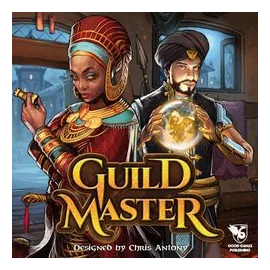
Guild Master is a fantasy tabletop game for 2-4 players. Players manage an adventuring guild, competing with each other to become the most famous guild as an escalating series of events threaten the land.
Core mechanisms
Key systems that shape the decisions players make.
Auction/Bidding
Bid against other players to determine who receives an item, action, or priority.
Action Queue
Place actions into an ordered queue that resolves now or on later turns.
Deck / Bag Building
Add new pieces during play to improve the cards, tokens, or dice drawn later.
Command Cards
Use cards to issue orders and determine which units or actions can activate.
Bribery
Offer resources or incentives to influence another player’s decision.
Read the full game description
Guild Master is a fantasy tabletop game for 2-4 players. Players manage an adventuring guild, competing with each other to become the most famous guild as an escalating series of events threaten the land. In each of the nine rounds, players simultaneously and secretly program orders to send teams of adventurers out to do the following: Recruit more adventurers. Attempt increasingly difficult contracts to gain money, fame and other rewards. Hire builders to upgrade their guild to increase their capacity to do all of that more. All players then sequentially resolve their planned orders, starting with each players' 1st order, then 2nd order and so on, and in the order they appear on the board (builders, then adventurers A-F then contracts 1-6). Players plan and program orders carefully around other players' likely moves, various strategies, risks, and rewards. They manage their guilds' growth and optimize combinations between their adventurer abilities and contract rewards to achieve their goals. As the game advances, guilds become more powerful and must rise to meet an increasing number of game state changing threats. Recruiting increasingly powerful adventurers and upgrading your guild capacity are both key to victory. There are various ways to exert control over the board, your dice rolls, and your chances to get what you want. Most orders are resolved by paying coin or rolling dice based on your adventurers' skills. Sometimes players resolve these orders alone, and sometimes cooperating with, or in conflict with, other guild's adventuring teams attempting the same thing at the same time. When players' orders overlap, coins and negotiated prisoners' dilemma cooperate/conflict skill checks resolve the contest. Negotiation over shared goals, contract bonuses and reward splits is encouraged and rewarding, but not absolutely required to win. Everything you do earns you fame (victory points) and other rewards. At the end of nine rounds, any remaining coins are converted to fame at a rate of 5 coins = 1 fame. Then any special prestige upgrade fame is added. The most famous guild is then declared the winner.