Overview
At a glance
Is this game right for my group?
ABG editorial scores on a 1–5 scale.
Harder to teach
High replayability
Highly interactive
Scales well
Deep strategy
How it plays
How does it play?
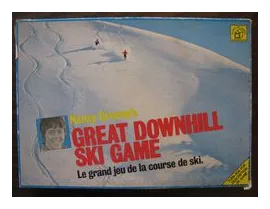
The Great Downhill Ski Game is a tile laying game for 1 to 4 skiers, with a large board of white squares, many with green triangles representing pine trees. There are 256 trail tiles showing the parallel lines the skis make in the snow.
Core mechanisms
Key systems that shape the decisions players make.
Read the full game description
The Great Downhill Ski Game is a tile laying game for 1 to 4 skiers, with a large board of white squares, many with green triangles representing pine trees. There are 256 trail tiles showing the parallel lines the skis make in the snow. These go in straight lines, diagonals, turns and sharp turns and a few have 2 trails making crossovers. Players draw ten tiles from the face-down pile and show them. The first player lays as many tiles as possible to make a ski trail down from the top of the hill avoiding the trees, then draws back to ten tiles. A player may choose to use its turn to swap tiles with the pool instead of playing. If your trail is totally blocked, you may remove tiles laid and try again. When a skier reaches the bottom of the hill, the others may finish their turns. Any finisher gets 25 bonus points, then each player scores their trail, according to the tiles they laid. The straights are worth 1 point, turns 2 pts, sharp turns 3 pts and crossovers are 10 pts. Then deduct the tiles left in hand and the highest total wins. In the solitaire game, the player draws 50 tiles and tries to make a trail using all 50. The rules are in English, French and German and refer to the board as a plastic sheet rolled in a tube, presumably the earlier edition. A slip in the box has trademark Terry Martin Rose and a company address Franklin Merchandising Co in Chicago. Nancy Greene (1943 - ) is Canada's most famous skier and it was not a surprise when her name and picture was added to the Canadian version. The Waddingtons edition must have been produced after the tube edition, as the rules text refers to unfurling the plastic sheet although the game has a standard board. The box has a copyright date of 1970. The tile count is different from the enclosed slip too, with 4 more straights, and 2 fewer of each hairpin turn. user summary