Overview
At a glance
Is this game right for my group?
ABG editorial scores on a 1–5 scale.
Harder to teach
High replayability
Highly interactive
Scales well
Deep strategy
How it plays
How does it play?
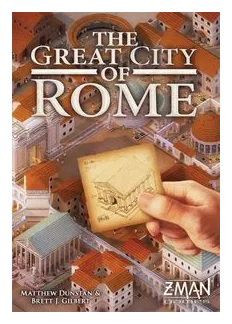
To rebuild the Eternal City, the Roman Emperor summoned the most talented builders of antiquity. Each of them is trying to draft the best city — but talent is not enough.
Core mechanisms
Key systems that shape the decisions players make.
Read the full game description
To rebuild the Eternal City, the Roman Emperor summoned the most talented builders of antiquity. Each of them is trying to draft the best city — but talent is not enough. Only those who know how to please the Emperor, cleverly exert their influence, and invest at the right time will succeed in City of Rome. In more detail, the game lasts fourteen rounds, and in each round, players draft one of the building cards in play and add it to their hand. The drafting order depends on how closely you stand to the emperor. At the start of a round, you reveal a new "action strip" that has three bricks and two cogs in some order, then players take turns placing their figure on one of these five spaces; the closer you are to the emperor, the earlier you draft, but the fewer resources (bricks and cogs) you receive. (With only two players in the game, each player places two figures on the action strip and takes two complete turns each round.) After drafting, you can take one build action and one produce action. To build, you must pay the cost in bricks — paying two coins for each missing brick — then place the card you're building adjacent to another card of yours already in play. You start with two building cards in play, so you'll have at most sixteen cards at game's end. These cards must fit in a 4x4 square, so plan carefully since you'll want to place some buildings next to other ones to earn the most points and to get the most out of a produce action. Some buildings give you a special action or influence tokens when you build them. To produce, you must have two cogs — paying one coin for each missing cog — then use the production action of each building in your city once. Every few rounds, an influence card is revealed, and whoever has the most influence tokens at the end of that round collects the card, then discards their tokens. At the end of fourteen rounds, players score points for their residential buildings, temples, aqueducts, coins, and influence cards and tokens. whoever has the most points wins!