Overview
At a glance
Is this game right for my group?
ABG editorial scores on a 1–5 scale.
Harder to teach
High replayability
Highly interactive
Scales well
Deep strategy
How it plays
How does it play?
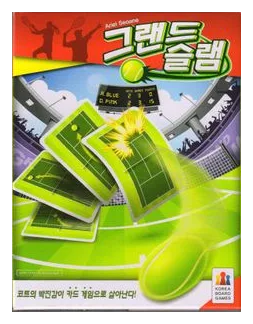
In Grand Slam, originally titled Love Means Nothing, each player has a deck of 24 cards, each of which depicts two parts of a tennis court: One half-court can be used for defense, returning a ball that comes your way; the other half-court can be used for offense, sending a shot across the net. You never use both halves of the card at once — either one or the other.
Core mechanisms
Key systems that shape the decisions players make.
Read the full game description
In Grand Slam, originally titled Love Means Nothing, each player has a deck of 24 cards, each of which depicts two parts of a tennis court: One half-court can be used for defense, returning a ball that comes your way; the other half-court can be used for offense, sending a shot across the net. You never use both halves of the card at once — either one or the other. A turn consists of first playing a card to cover the shot your opponent played, then playing another card to dictate which of the six zones you'll hit the ball to. Finally, you play a preparation card, indicating which zones you're prepared to cover. The preparation card can be used to cover a shot if the appropriate zone is highlighted; otherwise you must cover the shot with a card from your hand, in which case the preparation card becomes the attack. Thus, by playing cards that your opponent cannot cover with her preparation card, you maintain control of the match because you'll see from where the next attack will come and will be able to prepare for that. Of course if a player cannot cover a shot at all, then the point is lost. Combinations of cards can create special shots, which if not covered by the corresponding combination of cards, leave a player off balance, with her drawing only one card at the end of the turn instead of the usual two. This will leave her with fewer options and make it less likely that she'll cover your shots.